



Messengers from the Solar System's Edge
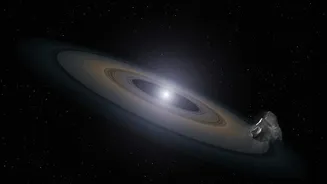
Beyond the orbit of Neptune lies a vast, doughnut-shaped region of icy, rocky bodies called the Kuiper Belt. This frozen frontier is home to comets, dwarf planets, and countless remnants from the solar system's formation roughly 4.6 billion years ago.
Because these objects have been in a deep freeze for so long, they are considered nearly perfect time capsules. The dust they shed, created by collisions or the slow erosion of their surfaces, is a precious resource. This dust carries chemical fingerprints of the conditions and materials that existed when the planets were first forming, offering a direct glimpse into our cosmic origins.
An Unlikely Collection Bin: The Stratosphere
It seems counterintuitive, but one of the best places to find dust from the outer solar system is high in our own atmosphere. Earth is constantly showered with an estimated 5,200 metric tons of cosmic dust each year. While most of it burns up or becomes indistinguishable from terrestrial dust, some particles survive the fiery descent. By using high-altitude aircraft, NASA can fly through the thin, pristine air of the stratosphere, a layer of the atmosphere where there is very little terrestrial contamination. Here, like filtering water for gold, specialised collectors can gently capture these microscopic interplanetary dust particles (IDPs) as they drift down from space.
The Proof is in the Damage
So how can scientists be sure a tiny speck came from the Kuiper Belt and not a nearby asteroid? The key is radiation damage. As dust grains travel through space, they are bombarded by energetic particles from the Sun, which leave microscopic scars, or 'tracks', in their crystal structure. By counting the density of these tracks, researchers can determine how long a particle has been exposed to the harsh environment of space. The twelve grains in this study had track densities about 100 times higher than dust originating from the main asteroid belt, indicating a much longer journey from the far reaches of the solar system.
What Twelve Grains Reveal
Despite their minuscule size—each only 10 to 30 micrometres across—these twelve grains have a big story to tell. Analysis shows they contain minerals like saponite and serpentine, which only form when liquid water interacts with rock. This suggests that the icy bodies they came from, now frozen solid in the Kuiper Belt, may have once had warm interiors where liquid water existed, possibly due to heat from radioactive decay or ancient collisions. Furthermore, the oxygen within these minerals is a 'heavy' isotope, a version of the element that points to a large reservoir of water in the outer solar system that was chemically distinct and largely isolated from the water found closer to the Sun.
A Different Kind of Water
The discovery of this heavy-water signature is profound. It provides compelling evidence that the solar system wasn't a well-mixed soup of ingredients. Instead, it seems there were distinct chemical zones that developed separately. The water that eventually formed Earth's oceans and the water locked away in the Kuiper Belt had different starting materials. These tiny dust particles are the first direct samples we have of this ancient, isolated reservoir. They challenge previous models and provide a more complex picture of how water and other materials were distributed during the solar system's chaotic youth. This finding deepens the mystery of Earth's water, but also provides new clues.