




A Sweet Discovery Near the Galactic Center
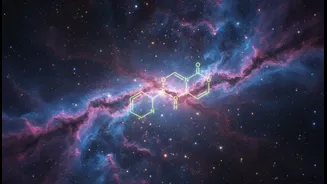
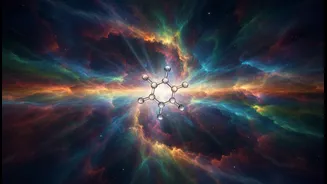
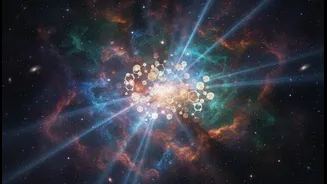
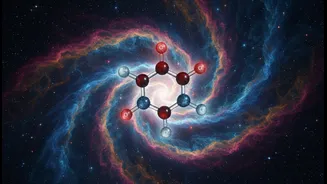
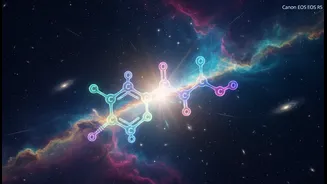
Astronomers have detected erythrulose, a four-carbon sugar, in a vast cloud of gas and dust known as G+0.693-0.027, located near the center of our Milky Way galaxy. Using powerful radio telescopes in Spain, an international team of scientists identified
the unique spectral fingerprint of the molecule floating in the interstellar medium—the sparse material that exists between stars. This marks the first time a sugar of this type has been directly identified in interstellar space, a major milestone for astrochemists. On Earth, erythrulose is a naturally occurring sugar found in small amounts in red raspberries.
Why This Sugar Is a Big Deal
Not all molecules in space are created equal. While scientists have found over 300 different molecules in the interstellar medium, the detection of erythrulose is particularly significant due to its complexity. It has a structure of 14 atoms, making it one of the largest non-cyclic molecules ever found in space, and the first to contain four oxygen atoms. Previously, scientists had found simpler sugars and sugar-related molecules on asteroids and meteorites, including ribose (a key component of RNA) in samples from the asteroid Bennu. However, finding a four-carbon sugar freely floating in a pre-stellar cloud confirms that such complex prebiotic molecules can form in the cosmos even before stars and planets are born.
Cosmic Factories for Life's Ingredients
So, how does a complex sugar form in the freezing, empty void of space? The discovery challenges the long-held view that large molecules in space form by adding one carbon atom at a time. Instead, scientists propose that erythrulose is built on the icy surfaces of tiny dust grains. These grains act as microscopic chemical factories. Simpler molecules, like two-carbon aldehydes and alcohols which are abundant in space, freeze onto these grains. Bombarded by cosmic rays, these simple molecules break apart and recombine into more complex structures like erythrulose. This process suggests a more efficient pathway for creating larger, life-relevant molecules than previously thought.
A Stepping Stone to Life?
The discovery of erythrulose doesn't mean we've found alien life, but it strengthens a key hypothesis about our own origins. A major puzzle in origin-of-life research is how the first sugars, which are crucial for forming RNA and DNA, appeared on early Earth, as conditions on our young planet were not ideal for producing them in large quantities. The theory of an 'exogenous origin' suggests these building blocks were delivered to Earth from space. The presence of erythrulose in an interstellar cloud shows that such molecules could be incorporated into comets and asteroids as they form. Scientists estimate that millions of tonnes of erythrulose could have been delivered to Earth during the Late Heavy Bombardment, a period of intense asteroid impacts billions of years ago, potentially seeding the primordial soup from which life emerged.
What's Next for Astrochemists
This groundbreaking finding opens up a new frontier in the search for life's ingredients. Now that they have successfully detected a four-carbon sugar, scientists are hopeful about finding other, even more critical sugars like ribose—the five-carbon sugar that forms the backbone of RNA—in the interstellar medium. The detection provides a direct link between the chemical factories of deep space and the prebiotic molecules necessary for life. It suggests that the raw materials for life might not be rare at all, but instead are common throughout the galaxy, waiting to be delivered to fledgling planets. The search continues, pushing the boundaries of what we know about our cosmic origins.