









The Philosophical Dawn: 2001: A Space Odyssey (1968)
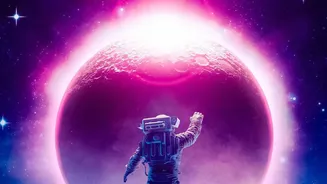
Stanley Kubrick’s masterpiece isn’t just a film; it’s a cinematic event that remains futuristic even today. Long before CGI, Kubrick pioneered effects that still feel completely convincing. He used meticulously crafted models, front projection, and colossal
rotating sets to simulate gravity, creating a sterile and believable vision of space travel. The film famously features very little dialogue, forcing the audience to immerse themselves in its stark imagery and classical music score. From the iconic 'Dawn of Man' sequence to the bewildering, psychedelic 'Stargate' journey, 2001 is a meditation on technology and evolution that uses its visual language to ask profound questions. It established a benchmark for sci-fi, proving that the genre could be both intellectually deep and visually spectacular.
The Weightless Nightmare: Gravity (2013)
Alfonso Cuarón’s survival thriller is a technical marvel designed to induce vertigo. The film’s brilliance lies in its ability to create a feeling of genuine weightlessness and terrifying isolation. This was achieved through a combination of groundbreaking visual effects from the studio Framestore and innovative filming techniques, including custom-built, computer-controlled rigs. Cuarón is famous for his long, seamless shots, and in Gravity, these extended takes place the viewer directly inside the helmet of a stranded astronaut. The physics of moving in a zero-gravity environment, the terrifying beauty of the Earth from orbit, and the visceral chaos of debris fields are rendered with breathtaking realism. It’s an immersive experience so complete that the big screen isn’t just recommended; it’s essential to feeling the full, heart-pounding impact of the story.
The Scientific Epic: Interstellar (2014)
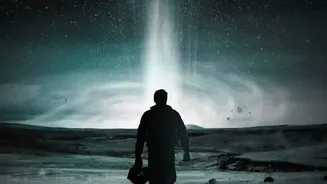
Christopher Nolan’s ambitious epic took cinematic science to a new level. To ensure scientific accuracy, Nolan and his effects team collaborated with theoretical physicist Kip Thorne to visualize complex astrophysical phenomena. Together, they created what is considered the first scientifically accurate depiction of a black hole on screen. Instead of relying on artistic license, the team developed new rendering software based on Thorne's equations to simulate how a real black hole would bend light and warp spacetime. The work was so groundbreaking it led to the publication of three scientific papers. The result is the mesmerizing and terrifying image of Gargantua, a supermassive black hole whose accretion disk forms a glowing halo above, below, and in front of its spherical shadow. This commitment to realism, combined with vast shots of desolate planets and wormhole travel, makes Interstellar a true spectacle of theoretical physics brought to life.
The Brutalist Beauty: Dune (2021)
Denis Villeneuve, who also directed Blade Runner 2049, has a unique talent for creating atmosphere through scale. His adaptation of Frank Herbert's novel is a masterclass in world-building, where every frame is packed with a sense of history and immense size. Production designer Patrice Vermette grounded the film in realistic settings, blending influences from Brutalist architecture to Japanese design to give each location a distinct identity. The visual effects were seamlessly integrated to enhance the physical world, not replace it, creating a tangible sense of place. From the colossal scale of the spaceships descending onto Arrakis to the god-like presence of the sandworms moving beneath the desert, Dune feels monumental. It is a film of texture, light, and shadow, designed to overwhelm the senses and convey the sheer vastness of its universe in a way only a cinema can.
The Dystopian Art Piece: Blade Runner 2049 (2017)
While more of a terrestrial sci-fi, the visual artistry of Blade Runner 2049 is so monumental it demands inclusion. Cinematographer Roger Deakins finally won an Oscar for his work here, and it’s easy to see why. Every frame is a perfectly composed painting of light, shadow, and color. Directed by Denis Villeneuve, the film expands on the original's noir aesthetic, creating a world that is simultaneously beautiful and haunting. Deakins and Villeneuve drew inspiration from real-world locations to create the smog-choked Los Angeles and the eerie, orange-dusted ruins of Las Vegas. The lighting is a character in itself, with massive, moving light sources and reflective water surfaces creating a dynamic and hypnotic environment. It’s a patient, philosophical film where the awe-inspiring visuals are central to its exploration of what it means to be human.