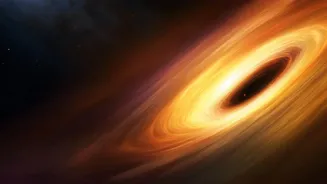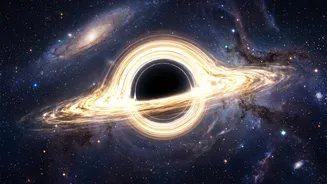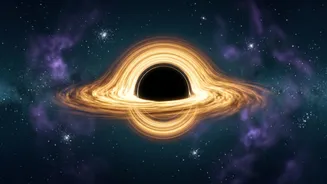



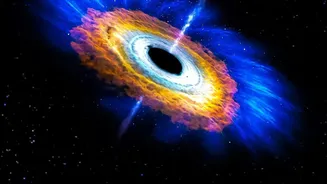
How do you find something that is, by its very nature, invisible? This is the challenge for astronomers searching for black holes. Now, a project is combining the power of a space telescope with the keen eyes of thousands of human volunteers.
A Universe of Data from TESS
The search
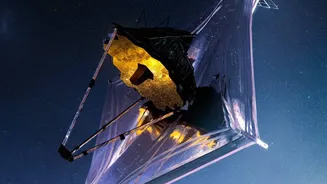
begins with NASA’s Transiting Exoplanet Survey Satellite, or TESS. Launched in 2018, its primary mission is to find exoplanets—planets orbiting stars outside our solar system. TESS does this by staring at hundreds of thousands of stars, measuring their brightness with incredible precision. When a planet passes in front of its star from our perspective, it causes a tiny, temporary dip in the star's light. TESS is designed to spot these dips. This method produces an immense amount of data, creating graphs of star brightness over time, known as 'light curves', for millions of stars. While built for finding planets, this firehose of information is also perfect for hunting other cosmic phenomena, including the tell-tale signs of hidden black holes.
The Challenge of Automated Searches
With millions of light curves to analyse, the obvious first step is to use computers. Automated searches and AI are essential for the initial sweep, flagging any light curve that shows interesting variations. However, algorithms have their limits. They are often trained to find specific, predictable patterns, like the uniform dip of a transiting planet. The signs of a black hole can be more unusual. For instance, if a black hole passes in front of its companion star, its immense gravity can bend and magnify the star’s light, causing a brief, sharp brightening—a phenomenon called 'gravitational self-lensing'. Computer programs can be fooled by the natural messiness of the cosmos; things like stellar flares or the normal pulsation of some stars can create false positives, tricking an algorithm into thinking it has found something significant. This is where the human brain has a distinct advantage.
Enter the Black Hole Hunters
To bridge the gap between machine speed and human intuition, astrophysicists created the Black Hole Hunters project. Hosted on the citizen science platform Zooniverse, the project enlists volunteers from the public to look at the light curves that have been sifted by computers. No special expertise is required; volunteers are shown examples of the patterns they are looking for and are simply asked to classify the graphs they see. Since its launch, nearly 23,000 volunteers have contributed, performing almost 12 million classifications. By having multiple people look at each light curve, the project averages out individual mistakes and builds a reliable consensus on which signals are truly promising.
The Power of the Human Eye
So what can a person spot that a computer might miss? Humans are exceptionally good at pattern recognition, especially when it comes to identifying novel or unexpected variations. An algorithm might be programmed to find a perfect, symmetrical peak caused by gravitational lensing. A human reviewer, however, can look at a slightly messy or asymmetrical peak and recognise it as a promising candidate that warrants a closer look, while simultaneously dismissing a graph showing the chaotic flickering of a stellar flare. It's this ability to interpret context and spot 'interesting weirdness' that automated systems struggle with. The project isn't about replacing computers but augmenting them. AI does the initial heavy lifting, reducing an ocean of data to a more manageable lake, and then human volunteers do the crucial work of fishing for the most promising catches.
A New Partnership in Discovery
This hybrid approach is proving to be a powerful model for modern scientific discovery. There should be millions of stellar-mass black holes in our galaxy, but so far only a small number have been confirmed. Most of these were found because they are actively 'feeding' on a companion star, a process that releases bright X rays. The Black Hole Hunters project is searching for the quiet, dormant black holes that don't produce these emissions and are otherwise invisible. By creating a crowdsourced shortlist of promising candidates, citizen scientists help professional astronomers use valuable and expensive time on large telescopes more effectively. Each classification helps narrow the search, and any volunteer could potentially be the one to spot the first evidence of a new, previously unknown black hole.