




Meet the Roman Space Telescope
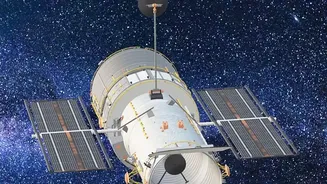
Scheduled for a late 2026 launch, the Nancy Grace Roman Space Telescope is poised to become a revolutionary tool for astronomy. Named after NASA's first chief of astronomy, this observatory has a primary mirror the same size as Hubble's but boasts a field
of view 100 to 200 times larger. This immense panorama means that where Hubble can see a single house in exquisite detail, Roman can capture the entire neighbourhood with the same sharpness. Its primary mission is twofold: to unravel the secrets of dark energy and dark matter, and to discover thousands of exoplanets, adding massively to the catalogue of worlds beyond our own. This ambitious agenda requires an equally ambitious machine, one built from components so advanced they push the boundaries of technology.
Two Eyes on the Cosmos
At the heart of the Roman telescope are two powerful instruments, each with a distinct job. The primary workhorse is the Wide Field Instrument (WFI), a gigantic 300-megapixel infrared camera that will conduct vast surveys of the cosmos. This is the tool that will map the structure of the universe and detect the subtle light-bending effects of distant planets. The second is the Coronagraph Instrument, a groundbreaking piece of technology designed for a more delicate task. A coronagraph works by blocking the blinding glare of a star, allowing astronomers to directly photograph the faint planets orbiting it—a feat notoriously difficult from Earth. The Roman Coronagraph is a technology demonstrator, a stepping stone intended to prove the advanced techniques needed for future missions that will search for Earth-like planets.
An Electronic Symphony
Building these instruments was a monumental task undertaken by teams across different institutions, including NASA's Goddard Space Flight Center and Jet Propulsion Laboratory, as well as industry partners. But building the parts is one thing; making them work together is another. The headline’s challenge refers to the crucial phase of systems integration. Think of it as conducting an orchestra. Each musician—the WFI, the Coronagraph, the power systems, the data processors—practiced their part perfectly in isolation. Integration is the first time the entire orchestra plays together. The spacecraft’s intricate web of electrical cables, its “nervous system,” must allow every component to communicate flawlessly, without interfering with one another. This process involves painstaking physical assembly followed by rigorous electronic and software testing to ensure the entire observatory can act as a single, cohesive entity in the unforgiving environment of space.
The High-Stakes Rehearsal
This integration testing is arguably one of the most critical stages in the telescope’s development. The instruments were subjected to tests that simulated the harsh conditions of launch and the extreme temperatures of space. Engineers meticulously checked for issues like electromagnetic interference, ensuring the powerful electronics of one system didn't disrupt the sensitive operations of another. Any unresolved glitch could spell disaster for the mission once it is a million miles from home, far beyond the reach of a repair crew. A single miscommunication between the guidance system and the imaging camera, or a power fluctuation affecting the coronagraph, could compromise the very science the telescope was built to perform. Passing these tests was the final, essential green light needed before the telescope could be cleared for its journey to the launchpad.