
A Planet's Shadow
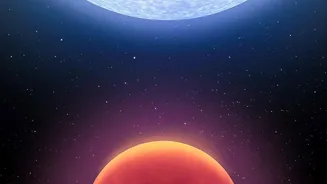
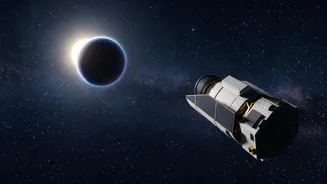
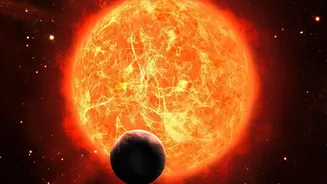
The first step in analysing a distant world's atmosphere is finding it and watching it move. Most exoplanets are detected using the 'transit method'. This involves monitoring a star for tiny, periodic dips in its brightness. That dip is the planet's shadow,
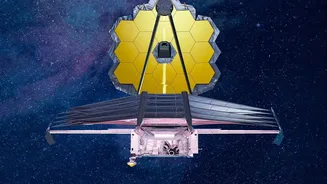
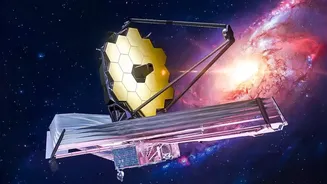
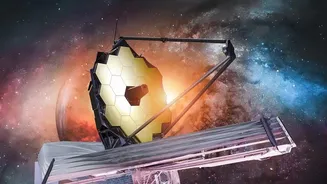
cast as it passes in front of its star from our point of view. This transit is not just a method for discovery; it's the critical moment when a planet's atmosphere becomes briefly visible to us, creating a perfect opportunity for analysis. Telescopes like NASA's James Webb Space Telescope (JWST) are designed to exploit these moments with incredible precision.
The Atmospheric Barcode
When a planet transits its star, a tiny fraction of the starlight filters through the planet's atmosphere. This is where the real magic, known as transit spectroscopy, happens. Different gases in the atmosphere absorb specific wavelengths, or colours, of light. As the starlight passes through, it picks up a chemical fingerprint of the air it travelled through. Back on Earth, astronomers can analyse this light, now missing certain colours, and read it like a barcode. Each element and molecule, from hydrogen to water to methane, has a unique absorption pattern, allowing scientists to piece together the chemical composition of an atmosphere on a world they can never physically visit.
Methane and CO2: The Chemical Duo
Among the thousands of possible chemicals, scientists are particularly interested in biosignatures—gases that, in combination, strongly suggest the presence of life. Methane (CH4) and carbon dioxide (CO2) are a key pair. On Earth, life, especially microbial life, is a massive producer of methane. While methane can be produced by geological processes like volcanoes, finding it alongside CO2 in a planet's atmosphere is a compelling hint. The James Webb Space Telescope has already successfully detected carbon dioxide on gas giants and is capable of spotting these molecules in the atmospheres of smaller, rocky worlds. Recent observations of the exoplanet K2-18b, for example, revealed both methane and carbon dioxide.
The Search for Imbalance
The strongest case for life isn't just finding one gas, but finding a combination of gases that shouldn't exist together. This is called chemical disequilibrium. On Earth, our atmosphere contains both oxygen and methane. These two gases naturally react with and destroy each other, so they shouldn't coexist in large amounts. The only reason they do is because life is constantly replenishing them. Finding a similar chemical imbalance on a distant exoplanet—like abundant methane and CO2 with very little carbon monoxide—would be a powerful indicator that some active, widespread process, possibly life, is at work maintaining that strange chemical cocktail.
The Power of Webb and Beyond
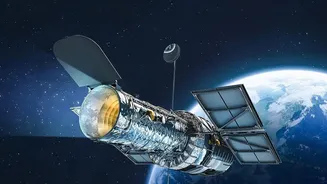
The James Webb Space Telescope is a game-changer in this field. Its powerful instruments are specifically designed to operate in the infrared, the part of the light spectrum where molecules like methane, carbon dioxide, and water vapour leave their most prominent absorption marks. This allows for an unprecedented level of detail in atmospheric analysis. While JWST has already made groundbreaking detections, it's just the beginning. Future ground-based Extremely Large Telescopes and next-generation space observatories will build on its findings, refining our techniques and pushing us closer to potentially answering whether we are alone in the universe.