



Harnessing the Power of Sunlight
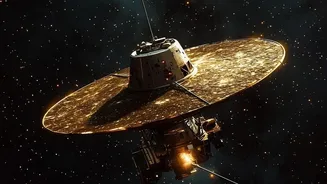
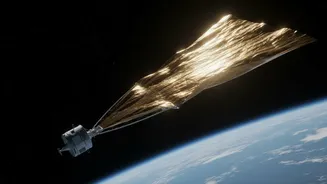
A solar sail works much like a sailboat on water, but instead of wind, it catches light. Light is made of particles called photons which, despite having no mass, carry momentum. When these photons strike a solar sail’s vast, highly reflective surface,
they transfer their momentum, giving the spacecraft a gentle but continuous push. In the frictionless vacuum of space, this tiny push, applied constantly over time, can accelerate a spacecraft to incredible speeds. Unlike chemical rockets that provide a powerful initial burst and then coast, a solar sail accelerates throughout its journey, as long as it is exposed to sunlight. This method of propulsion has an effectively infinite efficiency, since it consumes no onboard fuel.
The Problem with Conventional Rockets
Traditional space missions are governed by the tyranny of the rocket equation. The more you want to accelerate or the more massive your payload, the more fuel you need. But fuel itself has mass, which means you need even more fuel just to carry your fuel. This reliance on propellant severely limits the duration, distance, and scope of deep-space missions. Solar sails sidestep this problem entirely. By eliminating the need for propellant, spacecraft can be lighter and dedicate more of their mass to scientific instruments. This opens up possibilities for long-duration missions to the outer planets or even interstellar space, journeys that are simply not practical with current rocket technology due to the prohibitive amount of fuel required.
From Theory to Reality
The idea of sailing on light has been around since Johannes Kepler first observed comet tails being pushed by a solar force in the 17th century. For centuries, it remained science fiction. However, recent missions have proven its viability. Japan’s IKAROS spacecraft successfully demonstrated solar sailing during its flyby of Venus in 2010. More recently, The Planetary Society's crowdfunded LightSail 2 mission, which ended in 2022, successfully used a solar sail to change its orbit around Earth, proving the concept works for small, low-cost satellites called CubeSats. NASA is also pushing the technology forward with projects like the Advanced Composite Solar Sail System (ACS3), which deployed in 2024 to test new lightweight boom materials essential for future, larger sails.
Challenges on the Horizon
Despite its revolutionary potential, solar sailing is not without its challenges. The push from sunlight is extremely gentle, so acceleration is very slow. This makes solar sails less suitable for missions requiring rapid travel or quick manoeuvres near planets. Furthermore, building and deploying the massive, yet gossamer-thin, sails is a significant engineering feat. These structures, often the size of a small apartment or larger, must be packed into a small volume for launch and then unfurled flawlessly in space. The further a sail gets from the sun, the weaker the push becomes, diminishing its effectiveness in the outer solar system and beyond, where alternative light sources like high-powered lasers might one day be needed.
The Future of Interplanetary Travel
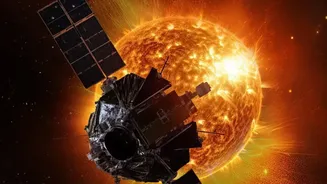
Engineers are already envisioning the next generation of solar sail missions. One concept, known as extreme solar sailing, involves flying a spacecraft extremely close to the Sun. The intense solar radiation pressure would give the sail a massive acceleration, flinging it toward the outer solar system at speeds far greater than any conventional rocket could achieve. NASA and NOAA are also exploring large sails to create stable observation posts for monitoring solar storms, providing earlier warnings for Earth. While sending humans on solar sails is still a distant prospect, the technology is perfect for robotic reconnaissance missions, communications relays, and eventually, the first generation of true interstellar probes.