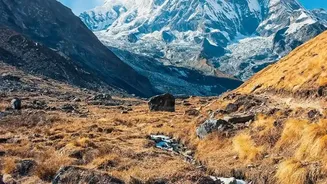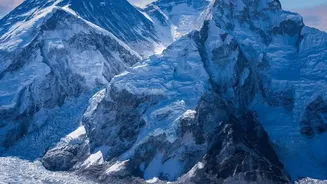





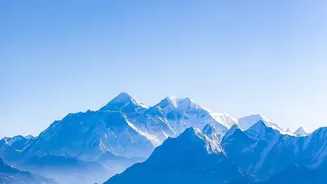
The Himalayas, often called Asia's 'water towers', are sounding an alarm. Recent UN-backed reports paint a stark picture of a region warming faster than the global average, dramatically increasing the risk of catastrophic glacial lake outburst floods.
A 'Third Pole' in Peril
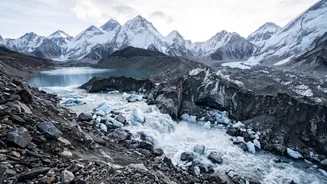
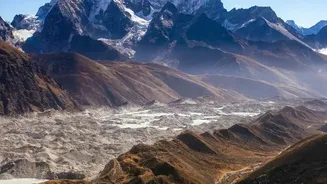
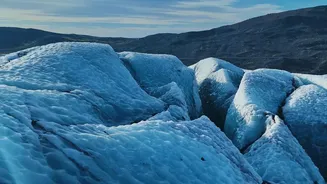
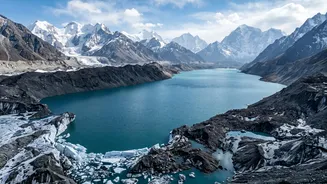
The Hindu Kush Himalaya (HKH) region holds the largest concentration of ice outside the polar regions, earning it the nickname the 'Third Pole'. This vast reservoir of snow and ice feeds ten major river systems, supporting nearly two billion people. But according to multiple recent reports from the United Nations and affiliated scientific bodies, this critical life source is becoming a significant hazard. As global temperatures rise, glaciers are retreating at an unprecedented rate, forming thousands of new and expanding glacial lakes. Many of these are held back only by unstable natural dams of rock and soil, creating what scientists call 'ticking time bombs'.
The Anatomy of a GLOF
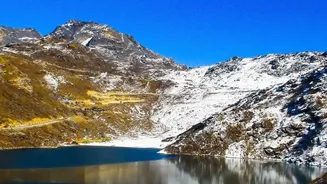
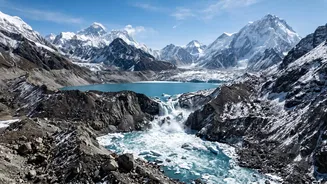
A Glacial Lake Outburst Flood, or GLOF, occurs when the fragile dam containing a glacial lake fails. This can be triggered by a number of events exacerbated by climate change: an avalanche of rock or ice crashing into the lake, the melting of ice within the dam itself, or simply the buildup of hydrostatic pressure as the lake grows. The result is a sudden, violent release of millions of cubic metres of water and debris that can travel dozens of kilometres downstream, destroying everything in its path. A recent UN-led study found that the frequency of GLOF events in the Himalayas is now nearly five times higher than it was before 1950, a surge directly linked to climate-driven changes. Events in recent years, such as the 2021 Chamoli disaster in Uttarakhand and the devastating South Lhonak lake flood in Sikkim in 2023, serve as grim reminders of their destructive power.
India's High-Stakes Vulnerability
While GLOFs are a transboundary threat across the HKH region, a pre-publication UN-led paper reveals a sobering statistic: India has recorded the highest number of deaths from these floods among eight Himalayan countries. Between 1835 and 2025, India experienced 6,119 fatalities from 62 recorded GLOF events. This highlights the immense human cost for communities living downstream. The reports underscore that the HKH region is warming significantly faster than the global average; a 1.5°C global rise could mean up to 2.2°C of warming in the Himalayas. This accelerated melt not only increases flood risk but also threatens long-term water security for millions in India who depend on glacier-fed rivers.
Key Findings from the Reports
The 'State of the Cryosphere 2026' and 'Overshoot and the Cryosphere' reports, released jointly by the UN Environment Programme (UNEP) and the International Cryosphere Climate Initiative (ICCI), stress that even if global warming is limited to 1.5°C, irreversible ice loss is already underway. One-third of the Hindu Kush Himalaya's glacier ice could still disappear. Earlier assessments by organisations like the International Centre for Integrated Mountain Development (ICIMOD) have identified hundreds of potentially dangerous glacial lakes across the region. A 2020 study alone flagged 47 high-risk lakes across basins in Nepal, China, and India, with experts believing the actual number is now significantly higher. The reports collectively warn that without urgent action, the scale and frequency of these disasters will only grow.
The Urgent Need for Action
The UN reports are not just a catalogue of risks; they are a call for immediate and coordinated action. The primary recommendation is a drastic reduction in global greenhouse gas emissions to slow the rate of warming. Alongside this, the reports call for a massive scaleup of adaptation strategies. This includes the development of robust, endtoend early warning systems that can provide timely alerts to downstream communities, a crucial element that can save lives. However, experts warn that technology alone cannot prevent all losses, especially along vast river systems. The reports also emphasise the need for transboundary cooperation, as many dangerous lakes are situated in one country but threaten communities in another, and for better infrastructure planning that accounts for the growing GLOF risk.