



A New Eye on the Cosmos
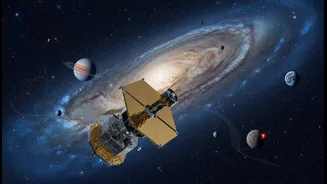
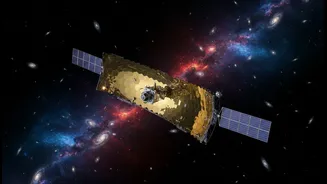
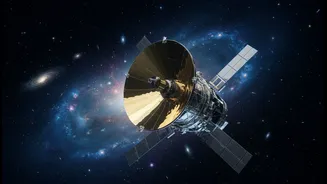
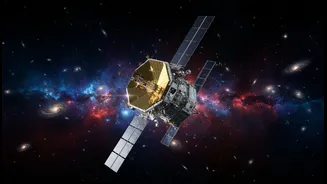
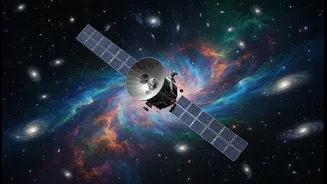
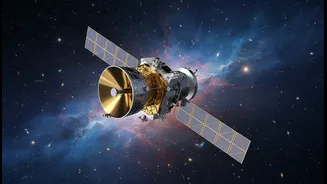
Meet the Nancy Grace Roman Space Telescope, NASA’s next-generation observatory scheduled to launch around August 2026. Named after Nancy Grace Roman, the agency's first chief of astronomy and the “Mother of Hubble,” this telescope has a unique mission.
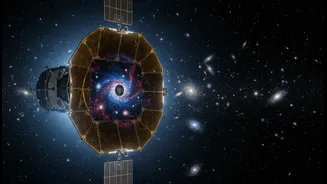
While telescopes like Hubble and the James Webb Space Telescope (JWST) act like magnifying glasses, zooming in on specific cosmic targets for a deep look, Roman is a wide-angle lens. It boasts a field of view 100 to 200 times larger than Hubble's infrared camera, allowing it to capture vast swathes of the sky with similar sharpness. This makes it less of a deep-diver and more of a grand surveyor, designed to map billions of galaxies and other celestial objects across the sky faster than ever before. Its primary mirror is the same size as Hubble's at 2.4 meters, but its advanced instrumentation will generate an unprecedented panoramic view of the universe.
Hunting for Dark Secrets
About 95% of the universe is composed of dark matter and dark energy, mysterious substances that we cannot see or directly detect. One of Roman's primary objectives is to shed light on these dark secrets. It will investigate dark energy, the enigmatic force causing the universe's expansion to accelerate, by using several methods. One key technique involves finding and studying thousands of distant Type Ia supernovae, which are exploding stars that serve as cosmic mile-markers. By measuring their distances and how fast they are moving away from us, scientists can map the expansion history of the universe with incredible precision. Roman will also map the distribution of dark matter by studying how its gravity subtly bends and distorts the light from distant galaxies, a phenomenon known as weak gravitational lensing. This data will help scientists test theories about the fundamental nature of the cosmos.
A Census of New Worlds
Beyond cosmology, Roman is poised to revolutionize the search for planets outside our solar system. Projections suggest the mission could discover tens of thousands, perhaps even over 100,000, new exoplanets. It will do this primarily using a technique called gravitational microlensing. This occurs when a star or planet passes in front of a more distant star, and its gravity acts like a lens, briefly magnifying the background starlight. This method is sensitive enough to find planets much smaller and farther from their host stars than other techniques, including rogue planets that don't orbit any star at all. While JWST can perform detailed atmospheric studies on individual planets, Roman's strength will be its sheer numbers, creating a massive statistical census of planetary systems to help us understand how common solar systems like our own really are.
Why the Evidence Still Matters
The Roman Space Telescope will generate an astonishing amount of data—far more than any previous astrophysics mission. Turning this torrent of information into knowledge is the real challenge. The headline's caution, "evidence still matters," is a crucial reminder of how science works. The telescope won't simply deliver a picture with a label that says "dark energy found here." Instead, it will provide raw data—brightness measurements, positions, and light spectra for billions of objects. Scientists must then painstakingly calibrate this data, formulate hypotheses, test them against the observations, and have their results scrutinized by other experts. For example, distinguishing a true planetary microlensing signal from the stellar noise of a crowded galactic core requires immense analytical rigor. Each potential discovery is a claim that must be backed by overwhelming evidence, a process that can take years. Roman's data will be the starting point for a new era of discovery, but every conclusion will be hard-won through the scientific process.