

Sailing on Sunshine
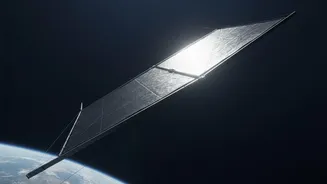
The concept of a solar sail is both elegant and simple. Instead of carrying heavy fuel, a spacecraft unfurls a vast, ultra-thin, mirror-like sail. This sail catches photons, which are particles of light from the sun. While photons have no mass, they have momentum.
As countless photons bounce off the reflective surface, they transfer their momentum to the sail, giving it a gentle but constant push. In the frictionless vacuum of space, this continuous acceleration allows a spacecraft to build up incredible speeds over time, far beyond what's possible with traditional chemical rockets that provide short, powerful bursts of energy. This method eliminates the need for propellant, which significantly reduces launch weight and mission costs, making it a promising technology for long-duration deep space exploration.
The Latest Breakthroughs
Recent advancements are moving solar sails from theory to practical application. NASA's Advanced Composite Solar Sail System (ACS3) mission, which launched in 2024, is currently testing new composite materials for the booms that deploy and support the sail. These carbon fiber booms are designed to be lighter, stiffer, and more resistant to temperature changes than previous metal versions. Following this, NASA has awarded a contract to the company Opterus to develop a much larger system. This new project will feature a sail spanning 1,600 square meters—roughly the size of an ice hockey rink—supported by 30-meter composite booms. This represents a sail area 20 times larger than that of the ACS3 system, marking a significant leap in scale and ambition. The goal is to create a stable, controllable sail that can reliably provide propulsion for future missions.
Not Without Its Challenges
Despite the immense potential, solar sailing faces significant hurdles. The push from sunlight is incredibly weak, so sails must be enormous yet lightweight to generate meaningful thrust. This makes them vulnerable to damage from micrometeoroids. Deployment is also a complex engineering challenge; unfurling a delicate, apartment-sized membrane from a container the size of a microwave oven in space is a high-stakes procedure. Furthermore, the thrust diminishes the farther the spacecraft travels from the sun, making it less effective in the outer solar system and beyond. Researchers are also working on improving maneuverability, which is currently more limited than with conventional thrusters. Overcoming these issues is key to unlocking the technology's full potential for navigating the cosmos.
The Future of Interstellar Travel
The successful development of solar sail technology could revolutionize space exploration. By removing the constraints of onboard fuel, missions could be designed for much longer durations and more ambitious destinations. This technology could enable low-cost missions to monitor space weather, survey near-Earth asteroids, and act as communication relays for future crewed missions to Mars and beyond. Some concepts, known as 'beam sailing', even envision using powerful ground-based lasers to push sails, providing a much stronger force than sunlight alone. This could potentially accelerate probes to a fraction of the speed of light, cutting travel time to the nearest stars from millennia to mere decades. While still in its early stages, the work being done today is laying the foundation for a future where humanity can reach farther into the universe than ever before.