



Planets and Meteors: What to Spot
This October is a fantastic month for planet-watchers and meteor fans. The biggest highlight is Saturn, which reaches opposition on October 4. This means Earth is directly between Saturn and the Sun, making the ringed planet appear at its brightest and best
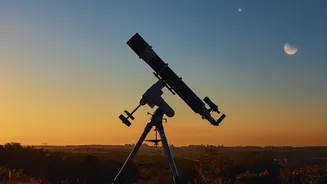
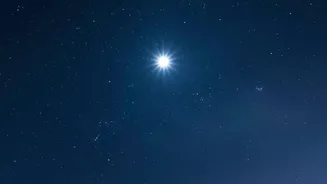
for the year. It will be visible all night long, rising in the east around sunset. While you'll need a telescope to see its famous rings, it will appear as a bright, steady, yellowish point of light to the naked eye. Mars and Jupiter are also making an appearance in the early morning sky. Look for the reddish hue of Mars and the brilliant light of Jupiter before sunrise. On October 5, Mars will have a close encounter with the crescent Moon, making for a beautiful pre-dawn sight. October also hosts two meteor showers. First are the Draconids, peaking on the evening of October 8-9. This is a gentle shower, with about 10 meteors per hour, but the moonless sky makes for excellent viewing conditions. Later, the Orionids, debris from Halley's Comet, will peak on the night of October 21-22. This shower is more active, with up to 20 fast, bright meteors per hour. The moon will be bright, but it sets a few hours before dawn, opening a perfect window for an early morning sky show.
Your Naked-Eye Toolkit
The most fundamental tool for stargazing is free: your own eyes. To make the most of them, the key is to find as dark a location as you can, away from the glare of city and street lights. Even a local park can be a significant improvement over your balcony. Once you're there, give your eyes at least 15-20 minutes to fully adapt to the darkness; you'll be amazed at how many more stars become visible. During this time, avoid looking at your bright phone screen. If you need a light, use a torch covered with red cellophane, as red light has less impact on your night vision. Familiarise yourself with a few key constellations. In the October sky, look for the great square of Pegasus high overhead. This can be your starting point to navigate to other star patterns. The famous W-shaped Cassiopeia is also prominent in the northern sky. Stargazing is a game of patience, so get comfortable. Use a reclining chair or lie on a blanket to avoid neck strain.
Level Up with Binoculars
A good pair of binoculars is arguably the best first investment for an aspiring astronomer. They are portable, easy to use, and reveal a staggering amount of detail. For stargazing, a pair of 7x50 or 10x50 binoculars are considered ideal. The first number is the magnification (7x or 10x), and the second is the diameter of the large lenses in millimetres, which determines how much light they gather. More light means brighter, clearer images of faint objects. With binoculars, the cratered surface of the Moon becomes a dramatic landscape. You can scan the dense star fields of the Milky Way, which will be setting in the west early in the evening. Aim them at Jupiter, and you might even glimpse its four largest moons, appearing as tiny pinpricks of light in a line around the planet. One of the best binocular targets this month will be Mars's journey through the Beehive Cluster (M44) around October 11, a sight that will be spectacular through a small instrument. To get the best view, keep your binoculars steady. Holding them can be tiring, so try bracing your elbows on a stable surface or consider investing in a simple tripod adapter.
An Observatory in Your Pocket
Stargazing apps have completely changed amateur astronomy. They turn your smartphone into a portable planetarium, helping you identify what you're seeing in real-time. Simply point your phone at the sky, and the app uses your location and internal sensors to show you the names of stars, constellations, planets, and even satellites passing overhead. For beginners, apps like SkyView Lite and Star Walk 2 are fantastic. They have intuitive, user-friendly interfaces and augmented reality (AR) modes that overlay information onto your camera's view of the sky. They can help you find Saturn or locate the radiant point of the Orionid meteor shower in the constellation Orion. For those wanting to go deeper, Stellarium Mobile is a powerful option, offering a vast catalogue of stars and deep-sky objects. Many of these apps also feature a red-light mode to preserve your night vision and can send you notifications for upcoming celestial events, so you never miss a thing.