






What Are Content Credentials?
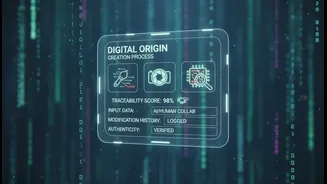
Think of Content Credentials as a “digital nutrition label” for a photo, video, or even an audio file. This label provides a secure, embedded history of the content, showing who created it, what tools were used, and how it has been edited. The goal isn't
to declare content as “true” or “false,” but to provide a verifiable trail of its origins—its provenance—so you can make a more informed decision about whether to trust it. This system is based on an open technical standard called C2PA, which stands for the Coalition for Content Provenance and Authenticity. This coalition includes major tech and media companies like Adobe, Microsoft, Google, Sony, and the BBC, all working to create a common framework for media transparency.
How Do They Actually Work?
When a creator uses a C2PA-compliant camera or software—like Adobe Photoshop or Lightroom—they can opt-in to attach Content Credentials to their file. This creates a cryptographically signed manifest, which is essentially a tamper-evident log of the content's history that gets embedded in the file itself. If the image is edited, that action is added to the log. If it's an AI-generated image from a compliant tool, the credentials will state that it was made by AI. When you encounter content with these credentials, you'll see a small icon. Clicking on it reveals this history. Any attempt to alter the file or its credentials after they've been signed will break the cryptographic seal, making the tampering visible.
The Promise of Transparency
For legitimate creators, journalists, and artists, Content Credentials offer a powerful way to prove authorship and protect their work's integrity. In a world where AI can mimic any style, a photographer can provide cryptographic proof that their image was captured by a real camera, not generated by a machine. News organizations can use it to show their audience the journey of a photograph from the field to the front page, building trust. It also brings accountability to the world of generative AI; compliant AI tools will label their own output, creating a clear distinction between synthetic and camera-captured media. This system is about adding a layer of verifiable information, giving honest creators a tool to stand by their work.
Why Deception Is Still Possible
Content Credentials are a significant step, but they are not a silver bullet against fake news or digital manipulation. The system's biggest limitation is that it's largely voluntary. A bad actor intent on creating deceptive content can simply choose not to use tools that support C2PA. Furthermore, the credentials can be stripped away. Taking a screenshot of a deepfake creates a new image file with no history, effectively bypassing the system. This is sometimes called the “analog hole.” Similarly, many social media platforms and messaging apps automatically strip metadata from files to save space, though this is slowly changing. Finally, a credential can prove a photo is authentic to the camera that took it, but it can't prove the scene itself wasn't staged or misleading.
Adoption Is Key
The success of Content Credentials depends entirely on a network effect. The more cameras, software applications, and social media platforms that adopt the C2PA standard, the more effective it will become. If content without credentials becomes the exception rather than the rule, it will be easier to spot media that warrants extra skepticism. However, this also creates a challenge: billions of legitimate photos and videos already exist without credentials, and we must avoid the trap of automatically branding them as “fake.” The absence of a credential doesn't mean a file is untrustworthy; it simply means there is no verifiable data attached to it. The road ahead involves not just building the technology, but also educating the public on how to interpret—and what not to infer from—these new digital labels.