



Magnification's Double-Edged Sword
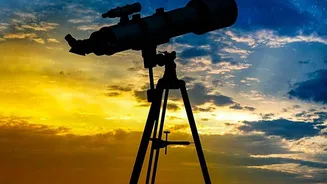
Observing planets requires high magnification to see any detail. But as you zoom in, you don't just magnify the planet; you magnify every tiny movement. A slight breeze, a footstep on the balcony floor, or even the act of focusing the telescope can send
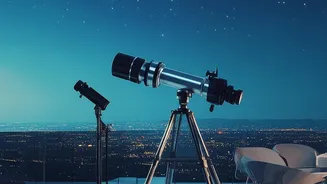
the image of Saturn jittering wildly across your eyepiece. A stable, well-built mount is designed to absorb and dampen these vibrations quickly. While a cheap, flimsy tripod might hold the telescope up, it will transmit and prolong these shakes, making any serious observation impossible. A good mount ensures that when you give the telescope a tap, the view settles in seconds, not minutes.
Chasing Planets Across the Sky
The Earth is constantly rotating, which means celestial objects appear to drift across the sky. At high magnification, a planet can move out of your field of view in less than a minute. A poor-quality mount makes re-centering the object a frustrating exercise of jerky, imprecise movements. A solid mount, however, provides smooth and controlled motion, allowing you to make tiny, precise adjustments to keep the planet perfectly centred. This is crucial for truly appreciating details like Jupiter’s Great Red Spot or the polar ice caps on Mars. Without smooth tracking, you spend more time chasing your target than actually observing it.
Alt-Azimuth vs. Equatorial Mounts
Telescope mounts generally come in two flavours: Altitude-Azimuth (Alt-Az) and Equatorial (EQ). Alt-Az mounts are simpler and more intuitive for beginners, moving up-down and left-right, much like a camera tripod. They are excellent for casual visual observation. Equatorial mounts are designed to counteract the Earth's rotation on a single axis, making them superior for long-exposure astrophotography and easier for keeping objects in the eyepiece over long periods once properly aligned. For visual planetary viewing from a balcony, a heavy-duty, computerised 'GoTo' Alt-Az mount can be an excellent, user-friendly choice, automatically finding and tracking objects for you.
The Unique Balcony Challenge
Observing from a balcony or wooden terrace presents unique stability challenges. Unlike setting up on solid ground in a field, these surfaces are prone to vibration. Every footstep can translate directly into a shaky view. Wind can also be more of a factor several storeys up, buffeting the telescope. This is where the mass and build quality of your mount become critical. Heavier, sturdier tripods provide a more stable base. Some astronomers also use anti-vibration suppression pads under the tripod feet. These inexpensive accessories are specifically designed to absorb and dampen vibrations from the floor, significantly improving image stability in such environments.
What to Look For in a Stable Mount
When choosing a mount, don't let it be an afterthought. Many experts argue the mount is just as, if not more, important than the telescope's optics. Look for a mount with a payload capacity that comfortably exceeds the weight of your telescope tube and any accessories you plan to add. A mount working near its weight limit will be far less stable. Check for sturdy tripod legs, preferably made of steel rather than aluminium, and a solid head with smooth, fine-adjustment controls. A good mount is a long-term investment that can serve you through several telescope upgrades, transforming a frustrating hobby into a deeply rewarding one.