
The Old Picture: A Chaotic Beginning
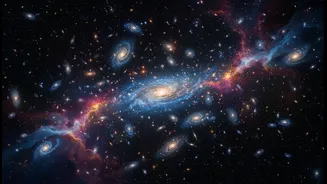
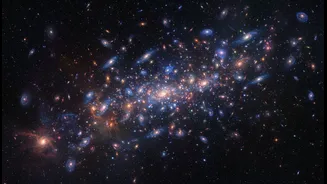
The long-held story of galaxy formation was a tale of gradual, bottom-up construction. In the hundreds of millions of years after the Big Bang, the universe was a turbulent place. The prevailing theory, known as the Lambda-CDM model, suggested that tiny
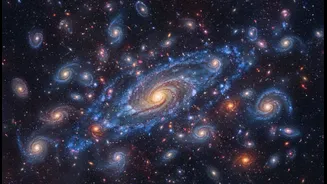
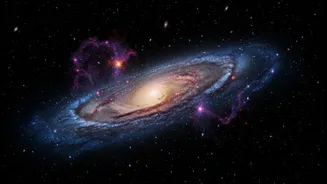
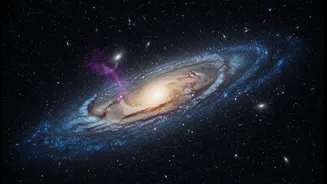
fluctuations in matter slowly pulled together small clumps of stars and gas. These protogalaxies were thought to be irregular and messy. Over billions of years, these smaller structures would repeatedly collide and merge, gradually building the grand, majestic spiral and elliptical galaxies that populate the modern cosmos. Scientists believed that complex structures like central bars—dense lanes of stars that stretch across a galaxy's core—were a mark of maturity, taking a vast amount of time to form in a stable, settled galaxy.
A New Glimpse of Cosmic Dawn
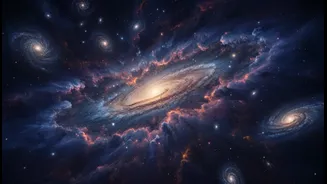
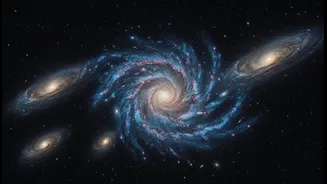
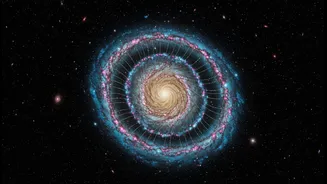
Enter the James Webb Space Telescope (JWST). With its unparalleled ability to capture faint, ancient light, it is providing a new window into the universe's infancy. And what it's seeing is forcing a major rethink. Astronomers are now finding galaxies with surprisingly complex and mature structures, like stellar bars and spiral arms, at a time when the universe was just a fraction of its current age. Some of these well-ordered galaxies have been spotted as they were just two billion years after the Big Bang, and in some cases even earlier. This is billions of years sooner than models had predicted. Finding features like a fully formed stellar bar—similar to the one in our own Milky Way—in a galaxy from 11 billion years ago is like finding a fully grown adult in a cosmic nursery.
The Power of an Infrared Eye
How is this possible? The credit goes to JWST's incredible sensitivity to infrared light. As the universe expands, the light from the most distant objects gets stretched into longer, redder wavelengths. The light from the earliest galaxies has been travelling for over 13 billion years to reach us, and by the time it arrives, it's firmly in the infrared part of the spectrum, which is invisible to the human eye and older telescopes like Hubble. JWST was specifically designed to capture this ancient light. By analyzing the different frequencies of this light, astronomers can not only determine a galaxy's distance and age but also deduce its shape, mass, and the types of stars within it. These capabilities have allowed scientists to identify distinct structures that were previously impossible to resolve.
Rewriting the Textbooks on Galaxy Growth
These discoveries pose a fascinating challenge to established theories. The presence of ordered structures like bars so early on suggests that the processes governing galaxy evolution might be far more efficient or rapid than we thought. Bars are thought to form in stable, rotating disks of stars, and the turbulent, gas-rich environment of the early universe was considered too chaotic to support them. The new findings imply that either galaxies were able to settle down from their chaotic beginnings much faster, or the bars themselves can form through different, more dynamic processes. Furthermore, these bars act like giant cosmic conveyor belts, funnelling gas and dust toward the galactic centre. This could explain another of JWST's surprising discoveries: the rapid growth of supermassive black holes at the heart of these early galaxies.
A Universe More Mature Than Expected
The discovery of early, structured galaxies is part of a broader trend in JWST's observations: the early universe appears to be more mature than anticipated. Scientists have found galaxies that are more massive and brighter than models predicted should exist so soon after the Big Bang. While some initial, dramatic claims of 'universe-breaking' discoveries have been tempered by further analysis, the underlying pattern remains. Galaxies seemed to assemble and organize themselves with startling speed. This doesn't break our fundamental understanding of the Big Bang, but it does force astrophysicists to refine their models of how the first stars and galaxies came into being. The story of cosmic evolution is proving to be even richer and more complex than imagined.