
The Challenge of Icy Worlds
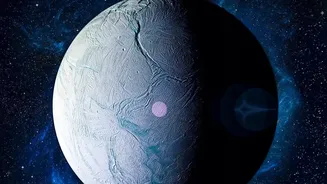
Europa is smaller than Earth's moon, but its hidden ocean may contain more than twice the water of all of Earth's oceans combined. This massive body of water is locked away beneath an ice shell estimated to be up to 30 kilometers thick. Directly drilling
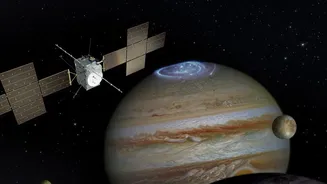
through that much ice is far beyond our current technological reach. Therefore, missions like NASA's Europa Clipper must rely on clever remote-sensing techniques to probe the moon's interior from orbit, carrying a suite of instruments designed to work together to build a picture of what lies beneath.
Seeing with Radar
The most direct method for peering into the ice is with ice-penetrating radar. The Europa Clipper mission carries an instrument called REASON, which stands for Radar for Europa Assessment and Sounding: Ocean to Near-surface. This instrument is the only one that can look directly into the icy shell. It works by sending out radio waves at two different frequencies (9 MHz and 60 MHz) from a 16-meter antenna. These waves travel down through the ice and bounce off any boundaries they encounter, such as cracks, pockets of liquid water, or the big one: the ice-ocean interface. By measuring the time it takes for the signals to return and how much their energy has changed, scientists can map the ice's internal structure and, most importantly, determine its thickness, giving them the top boundary of the ocean.
The Magnetic Field Clue
Another powerful tool is the magnetometer. Jupiter has an immense and powerful magnetic field that constantly sweeps over Europa as the moon orbits. A global ocean of salty water is an excellent electrical conductor. As Jupiter's magnetic field washes over Europa, it generates, or induces, a secondary magnetic field within the salty ocean. The Europa Clipper Magnetometer (ECM) is designed to measure this weak induced field. The strength and behavior of this secondary field depend on the ocean's properties. By analyzing it, scientists can infer the ocean's depth, thickness, and its salinity (how salty it is). This technique provided the first strong evidence for Europa's ocean from the Galileo mission in the 1990s.
Weighing the Water with Gravity
A third, more subtle method involves using the entire spacecraft as a scientific instrument to measure Europa's gravity field. As Europa Clipper performs dozens of close flybys, powerful antennas on Earth from the Deep Space Network will track its radio signal with extreme precision. Tiny pulls from Europa's gravity will slightly alter the spacecraft's trajectory, causing a minute change in the frequency of its radio signal—a Doppler shift. Because Europa's non-circular orbit causes it to be constantly flexed and stretched by Jupiter's gravity, its shape changes slightly. The extent of this tidal deformation depends on its internal structure. A solid moon would flex very little, but a moon with a liquid ocean beneath a flexible ice shell will stretch more. By measuring these gravitational wobbles, scientists can constrain the thickness of both the ice shell and the ocean below.
A Symphony of Science
No single instrument can provide all the answers. The true power of a mission like Europa Clipper comes from combining the data from all its instruments. The radar provides a direct measurement of the ice shell's thickness in specific locations. The magnetometer gives a global perspective on the ocean's conductivity and depth. The gravity science experiment reveals how the entire moon flexes, providing further constraints on the ice and ocean layers. Together, these instruments create a complementary and overlapping set of data that will give scientists their most detailed understanding yet of the vast, hidden ocean on Europa, a critical step in assessing whether this distant world could harbor life.