




The Search for Cosmic Company
The search for extraterrestrial intelligence, or SETI, is one of the most profound scientific quests ever undertaken. Founded in 1984 as a formal, non-profit organisation, its mission is to explore and understand the prevalence of life and intelligence in the universe.
Instead of sending probes or astronauts across the unfathomable distances of space, SETI scientists take a more pragmatic approach: they listen. They scan the skies not for little green men, but for 'technosignatures'. A technosignature is any measurable, scientific evidence of technology. It’s the cosmic equivalent of spotting smoke from a distant campfire; it doesn't show you the people, but it proves someone is there. These signs could be anything from the chemical pollutants of a massive industrial society to artificial light from alien cities, but for over 60 years, the primary search has focused on one thing: radio waves.
Why Radio Waves Are the Go-To
So why place such a huge bet on radio? The logic is rooted in physics and efficiency. Radio waves are a form of light, and they travel at the fastest speed possible through the universe. Unlike visible light, they can pass through the vast clouds of interstellar dust and gas that obscure much of the galaxy, making them ideal for long-distance communication. Furthermore, creating and sending a radio signal is relatively cheap in terms of energy. Any civilization that has developed technology is likely to have discovered radio, just as we did. Scientists theorise that a deliberately sent signal would be a 'narrowband' transmission. Natural cosmic sources, like stars and pulsars, tend to broadcast noise across a wide range of frequencies. A signal packed into a very narrow frequency, however, would stand out against the background static as distinctly artificial—a clear sign of technology.
Tuning into the 'Water Hole'
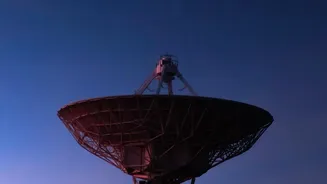
To narrow the search, early pioneers of SETI, like Philip Morrison and Giuseppe Cocconi, suggested focusing on a specific, quiet part of the radio spectrum known as the 'water hole'. This is a frequency range between the natural emissions of hydrogen (H) and hydroxyl (OH) molecules—the components of water (H2O). Since water is fundamental to life as we know it, they reasoned that another intelligent species might see this band as a logical, universal place to 'meet' for a cosmic chat. It is one of the quietest parts of the radio sky, making it an ideal spot to listen for an artificial beacon. Giant radio telescopes, like the former Arecibo Observatory and the Allen Telescope Array, have spent countless hours pointed at the stars, listening intently in this special band for any signal that seems out of place.
The Great Silence and a Famous 'Wow!'
Despite decades of listening, the universe has remained stubbornly quiet. This phenomenon is often called the 'Great Silence'. There have been tantalising moments, however. The most famous is the 'Wow! signal', a powerful, narrowband radio burst detected in 1977 by the Big Ear radio telescope in Ohio. It lasted for 72 seconds and had all the hallmarks of an artificial signal, but it was never heard again despite numerous follow-up searches. While it remains the most compelling candidate for an alien transmission, most scientists now believe it was likely a rare, natural phenomenon that has yet to be fully explained. The search is incredibly difficult; a signal could be too weak, too brief, or simply get lost in the noise of the cosmos.
Beyond the Radio Dial
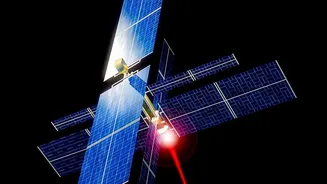
Recognizing the limitations of focusing only on radio, the modern search for technosignatures has expanded. Scientists are now looking for other signs of technology. 'Optical SETI' searches for powerful, brief flashes of laser light, which could also be used for interstellar communication. Other researchers are analysing the atmospheres of distant exoplanets for signs of industrial pollutants like chlorofluorocarbons. Perhaps the most ambitious searches are for 'megastructures'—hypothetical, massive engineering projects like a 'Dyson sphere', which a civilization might build around its star to harvest its energy. Such a structure would give off a distinct waste heat signature in infrared light. These new methods acknowledge that an alien civilization, especially one far more advanced than ours, might not use radio at all.