


A Hexagon's New Sibling
For decades, scientists have been fascinated by a massive, stable, six-sided jet stream encircling Saturn's north pole, famously known as 'the hexagon'. First spotted by the Voyager probes in the 1980s, this feature has been a unique and enduring puzzle
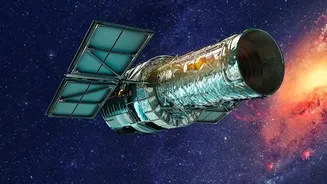
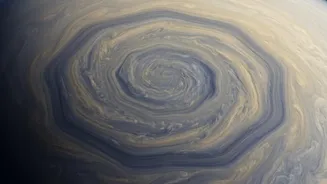
in our solar system. Scientists had long searched for a similar structure at the south pole, but missions like NASA's Cassini, which orbited the planet from 2004 to 2017, found no such counterpart. This led to the belief that the northern hexagon was a one-of-a-kind phenomenon. However, recent observations have completely changed that view. New images, pieced together from Hubble's annual Outer Planet Atmospheres Legacy (OPAL) program, have unveiled a giant, 10-sided atmospheric wave—a decagon—forming around the south pole.
An Unexpected and Evolving Feature
What makes this discovery so surprising is not just the existence of a new polar polygon, but its dynamic nature. While the northern hexagon has remained remarkably stable for over 40 years, the southern decagon appears to be a relatively new and developing feature. By reviewing archival Hubble data, researchers found faint hints of the structure emerging as far back as 2023, with it becoming much more defined in subsequent years. This gives scientists a rare and precious opportunity to watch a giant atmospheric pattern develop in real-time. The discovery was made possible as Saturn's 29-year orbit and seasonal tilt gradually brought its south pole back into view from Earth, allowing both ground-based observatories and Hubble to get a clear look.
The Science Behind the Shapes
These massive geometric patterns are essentially jet streams, powerful currents of air that create atmospheric whirlpools called polar vortices. On Earth, our jet streams are wavy and irregular, but on gas giants like Saturn, they can form stable, symmetrical shapes. The northern hexagon is a towering structure, with evidence suggesting it extends hundreds of kilometres vertically through different layers of the atmosphere. The new southern decagon also appears to be a deep, vertically extended wave, not just a superficial cloud pattern. Why one pole would form a hexagon and the other a decagon is a new mystery for planetary scientists. The formation of these patterns is believed to be linked to the planet's rotation, internal heating, and the properties of the gases deep within its atmosphere.
What This Means for Planetary Science
This discovery reshapes our understanding of Saturn's atmospheric dynamics. The fact that the planet can host two different, large-scale polygonal patterns suggests that the forces creating them are more complex than previously thought. It indicates that the northern hexagon may not be as singularly extraordinary as once believed. Observing the decagon as it strengthens and evolves will provide invaluable data for computer simulations that model how such features are born and sustained. This, in turn, could offer clues about the conditions deep inside the planet's interior. Scientists are eager to continue monitoring the south pole with both Hubble and the James Webb Space Telescope to see how this new feature changes over time and what it can teach us about the weather on gas giants.