


Listening to Cosmic Echoes
Imagine dropping a stone into a perfectly still pond. The ripples that spread out tell you about the stone and the impact, even if you never saw it. Gravitational waves are like that, but on a cosmic scale. First predicted by Albert Einstein, they are invisible
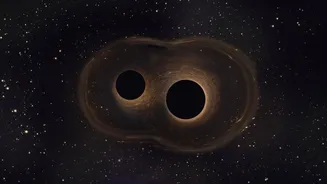
ripples in the very fabric of spacetime, created by extremely violent and energetic events, like the collision of black holes. For decades, they were purely theoretical. But since 2015, observatories like LIGO in the United States, Virgo in Italy, and KAGRA in Japan have been able to detect these faint tremors. This has opened up a whole new way of observing the universe, allowing us to witness events that are otherwise completely dark and invisible. Each detected wave is a ghost of a cataclysm, carrying precious information across millions or billions of light-years.
The Missing Middleweights
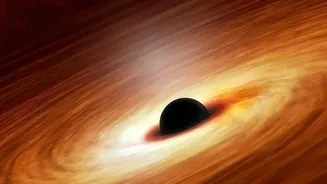
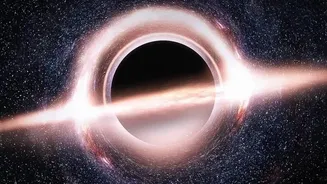
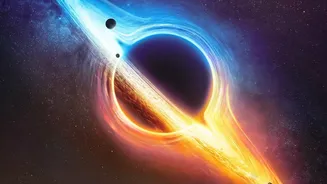
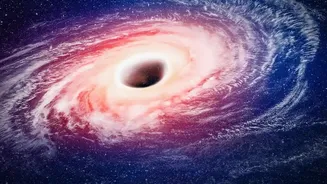
In the world of black holes, astronomers have long known about two main sizes. There are stellar-mass black holes, typically 5 to 100 times the mass of our sun, which form from the collapse of giant stars. Then there are the supermassive black holes, monsters that are millions or even billions of times our sun's mass, found lurking at the heart of most large galaxies, including our own Milky Way. But what about in between? The existence of intermediate-mass black holes (IMBHs), ranging from 100 to 100,000 solar masses, has been a long-standing puzzle. They are the 'missing link' in black hole evolution. Finding them is key to understanding how the supermassive giants could have grown so large, so quickly, in the early universe.
A Collision of Titans
The latest findings from the global network of gravitational wave detectors have provided the most compelling evidence yet for not just the existence of IMBHs, but for their role as cosmic architects. By analyzing the specific 'chirp' of gravitational waves from distant collisions, scientists can determine the mass and spin of the objects that merged. Recent detections have pointed to collisions involving these elusive mid-sized black holes. One scenario gaining significant traction is called 'hierarchical merging'. This is the idea that smaller, stellar-mass black holes merge to form a slightly larger one. This new, heavier black hole can then merge again, and again, climbing the mass ladder. Recent simulations and observational data suggest this process can happen rapidly in the dense, crowded cores of star clusters.
Architects of Galactic Cores
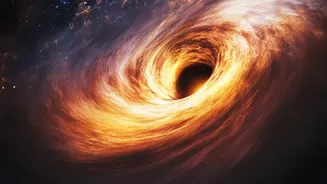
This is where the story gets truly epic. The headline-making claim is that these IMBH collisions are not just isolated events; they are a fundamental process driving the evolution of galactic cores. The theory is that dense star clusters, acting as cosmic nurseries, facilitate a runaway process of black hole mergers. These repeated collisions build up an IMBH. If that star cluster is then pulled towards the center of its host galaxy, its IMBH can merge with other black holes, eventually creating the supermassive black hole at the galaxy's heart. We are effectively seeing the construction method for the universe's largest structures. It suggests that the hearts of galaxies are built, not born, through a series of violent, powerful mergers over billions of years.
Rewriting Cosmic History
This discovery forces us to rethink the timeline of galaxy formation. The presence of huge supermassive black holes in the very early universe has been a major puzzle, as it's hard to explain how they grew so big so fast. The IMBH hierarchical merger pathway provides a plausible solution. It suggests that the 'seeds' of supermassive black holes weren't necessarily tiny, but were themselves already quite large IMBHs built through successive collisions. The latest data from gravitational wave catalogs, which have nearly doubled the number of known black hole collisions, are providing a wealth of information to test these theories. We are no longer just theorizing about these events; we are observing their echoes and using them to map the universe's assembly line.