


The Basic Idea Isn't the Whole Story
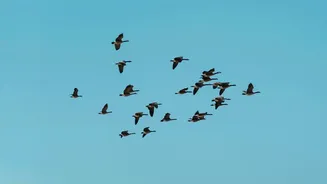
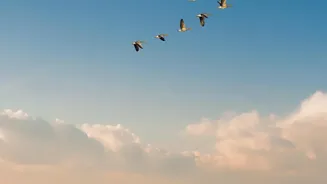
For years, the common wisdom was that birds fly in a V to 'draft' off each other, much like cyclists in a peloton, using the bird in front to block the wind. While not entirely wrong, this simple explanation misses the beautiful complexity of what's really
happening. The real secret lies not in blocking the wind, but in using the air that the lead bird has already moved. It’s a sophisticated aerodynamic strategy that allows the entire flock to fly farther while using significantly less energy, a crucial advantage for birds undertaking epic migrations across continents and oceans.
Harnessing the Power of Upwash
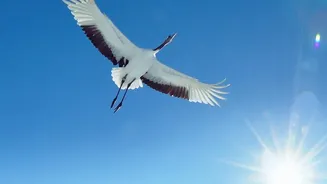
The key to the V-formation is a phenomenon called 'upwash'. As a bird flaps its wings, it creates a rotating vortex of air spinning off its wingtips. Directly behind the bird, the air is pushed downwards (downwash), which is 'bad air' for a following bird. But to the sides of the bird's flight path, that same vortex creates an upward current of air called upwash, or 'good air'. This upwash provides a free lift, much like a surfer catching a wave. By positioning themselves precisely in the upwash zone of the bird ahead, trailing birds get a boost that helps them stay aloft with less effort. It is an invisible wave of energy that the birds have learned to ride with incredible precision.
A Feat of Perfect Timing
Catching this free lift is not as simple as just flying in the right spot. To truly benefit, the birds must also synchronise the timing of their wingbeats. Studies on Northern bald ibises, using incredibly precise GPS trackers, revealed that trailing birds adjust their flapping phase to match the bird in front of them. This allows them to keep their wingtips in that sweet spot of rising air throughout the entire flap cycle. This level of coordination is remarkable, demonstrating that birds have an innate awareness of the air currents around them and can make millisecond adjustments to exploit them. Recent aerodynamic models show that by doing this, a trailing bird can reduce the amplitude of its wing flaps by as much as 30 percent while maintaining the same speed.
The Measurable Energy Savings
This isn't just theory; the energy savings have been measured in the wild. Pioneering studies involving Great white pelicans trained to fly with heart rate monitors showed a significant drop in heart rate — between 11% and 14% — when flying in formation compared to flying solo. Those birds also flapped their wings less frequently and could glide for longer periods. While the exact energy savings can vary depending on the species, size of the flock, and position in the V, studies have suggested efficiency gains ranging from a conservative 11% to as high as 32%. For an animal undertaking a journey of thousands of kilometres, a saving of this magnitude can be the difference between survival and starvation.
A Cooperative Effort of Shared Burdens
The V-formation is not a system where the flock selfishly exploits a single leader. The bird at the very front of the V gets no aerodynamic advantage; in fact, it faces the most resistance and works the hardest. To solve this, flocks engage in a remarkable display of cooperation. Studies show that birds regularly rotate the lead position, allowing the flock to share the burden of the most demanding role. Some research observed that Northern bald ibises often worked in pairs, frequently swapping positions to ensure both birds spent equal time benefiting from each other's wake. This act of reciprocal altruism turns the flock into a single, hyper-efficient unit, ensuring that the group as a whole conserves as much energy as possible. It is a social solution to a physical problem.