







Beyond the Red Squiggle
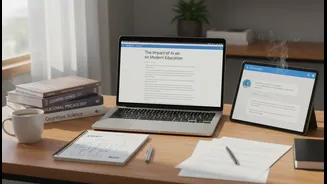
For decades, students have relied on basic spell checkers and grammar tools, the digital equivalent of a red pen pointing out typos. Today's AI writing assistants, however, are in a different league entirely. These sophisticated platforms go far beyond
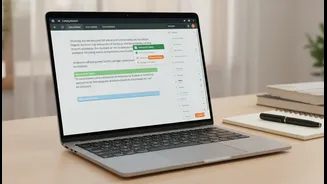
simple error correction. They function as an on-demand writing coach, offering feedback on everything from sentence structure and clarity to the overall flow and coherence of an argument. These tools can suggest stronger synonyms, flag awkward phrasing, and even analyze the tone of a piece to ensure it matches academic standards. Some can even help generate counterarguments for students to consider, pushing them to think more critically about their own claims. This evolution marks a significant shift from mere proofreading to actively enhancing the quality of writing.
An AI-Powered Study Partner
So how are students using these tools in practice? Many are integrating them into their writing process as a final 'self-check' before submission. After completing a draft, a student might run it through an AI assistant to catch recurring grammatical errors they are prone to making. They might use a paraphrasing tool to rephrase a clunky sentence or a summarizer to ensure a paragraph clearly communicates its intended point. Critically, this is not about generating text from scratch. Instead, it's an iterative process of refinement. Students report using these tools to get immediate feedback, allowing them to learn from their mistakes in real-time and improve their skills, rather than waiting days for a professor's notes. This instant feedback loop helps build confidence and reduces the anxiety often associated with academic writing.
The Polished Payoff
The result, according to educators and students, is a more polished final product. Papers that have undergone an AI self-check often exhibit improved clarity, better organization, and more robust arguments. By handling the 'mechanical tasks' of proofreading and formatting, AI assistants free up students to focus on the higher-order aspects of writing, such as critical thinking and complex analysis. This not only helps them produce better work and achieve better grades but also teaches them what good academic writing looks like by providing concrete examples and explanations for suggested changes. The process can help students internalize writing conventions, leading to durable knowledge and improved skills over time.
Navigating the Ethical Tightrope
The rise of these powerful tools naturally raises concerns about academic integrity. Where is the line between a helpful editing tool and a ghostwriter? This is the central question educators and institutions across India are grappling with. Most agree that turning in unedited, AI-generated text as one's own work constitutes plagiarism. However, a total ban on AI seems futile and counterproductive, especially as these tools become integrated into standard software. Instead, the focus is shifting towards developing clear guidelines for responsible use. Many educators are now teaching students how to use AI ethically—as a partner for brainstorming and revision, not as a replacement for original thought. The goal is to foster a culture of transparency where students acknowledge their use of AI tools appropriately.
The Educator's Evolving Role
Rather than viewing AI as a threat, many educators are embracing it as the next evolution in learning technology, much like the calculator changed mathematics education. They argue that these tools can supplement, not replace, traditional instruction. By automating feedback on grammar and syntax, AI allows teachers to focus their limited time on more substantive aspects of a student's work, such as the strength of their research and the originality of their ideas. Some instructors are even designing assignments specifically around AI, asking students to critique AI-generated text or use the tools to explore different angles on a topic. This approach prepares students for the modern workplace, where the ability to use AI effectively and ethically is becoming an increasingly valuable skill.