

The Sun’s Violent Threat to Earth
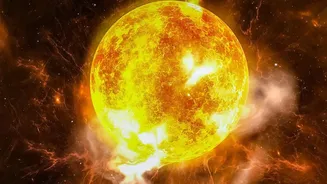
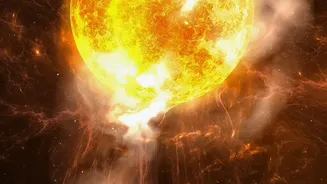
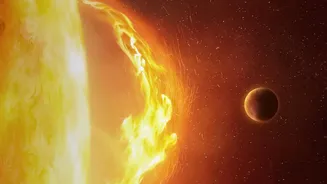
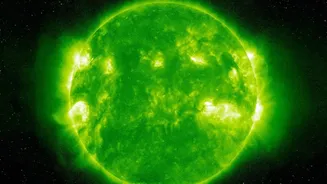
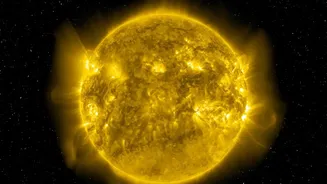
The Sun, our life-giving star, has a turbulent side. It periodically unleashes colossal explosions of plasma and magnetic fields known as Coronal Mass Ejections (CMEs). When these solar storms are aimed at Earth, they can have devastating consequences.
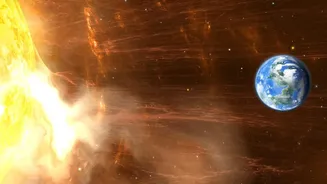
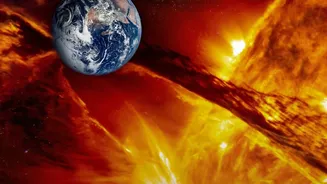
Travelling at immense speeds, they can slam into our planet's magnetic shield, triggering severe geomagnetic storms. In a world reliant on technology, the stakes are incredibly high. These storms can overload power grids causing widespread blackouts, disrupt crucial satellite communications and GPS navigation, and pose a radiation risk to astronauts and air travel. As our dependency on space-based assets and interconnected power systems grows, so does our vulnerability to this celestial threat. Predicting when these storms will occur and how they will impact Earth is one of the most critical challenges in space science.
India’s Eye on the Sun
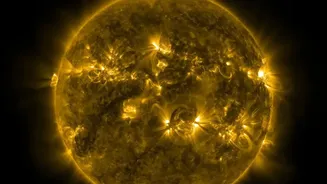
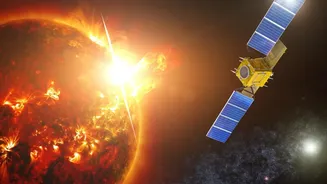
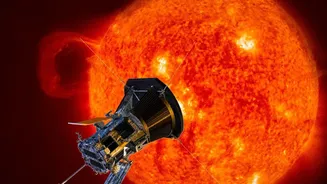
Enter Aditya-L1, the Indian Space Research Organisation's (ISRO) first dedicated solar mission. Launched in September 2023, it is strategically positioned at Lagrange Point 1 (L1), a gravitationally stable spot about 1.5 million kilometres from Earth. From this unique vantage point, Aditya-L1 has an uninterrupted, 24/7 view of the Sun, free from the eclipses that hinder Earth-orbiting satellites. Its primary mission is to observe the Sun's outer atmosphere, the corona, and understand the dynamics that drive solar eruptions. Equipped with a suite of seven advanced instruments, Aditya-L1 is not just an observatory; it's an early warning system designed to give us the crucial head start needed to prepare for incoming space weather.
A Breakthrough in Early Detection
The latest advancements stem from observations made by Aditya-L1's primary payload, the Visible Emission Line Coronagraph (VELC). In a landmark achievement, VELC has captured the first-ever spectroscopic signatures of the very beginning, or onset phase, of a CME. By analysing the light from the Sun's corona, scientists can now detect crucial changes in temperature, density, and velocity as a CME begins to lift off from the solar surface. For instance, during a July 2024 event, researchers observed a 30% increase in temperature and a significant increase in turbulence in the region where a CME was forming. It also detected the ejected plasma moving away from the observer at about 10 kilometres per second. This detailed, real-time data from the CME's birthplace is a game-changer for forecasting.
How the VELC Instrument Works
The VELC is an engineering marvel, an internally occulted coronagraph designed and built by the Indian Institute of Astrophysics. A coronagraph works by creating an artificial eclipse inside the telescope, blocking the blindingly bright light from the Sun's main disk. This allows it to see the much fainter corona surrounding it. What makes VELC exceptional is its ability to observe closer to the solar limb (at 1.05 solar radii) than most contemporary space coronagraphs. This proximity allows it to capture the crucial first moments of an eruption that other instruments might miss. By not just taking a picture, but also breaking down the light into its component parts (spectroscopy), VELC provides a wealth of information that helps scientists model the CME's trajectory and potential intensity with far greater accuracy.
From Better Forecasts to Stronger Protection
This enhanced forecasting capability has profound real-world implications. More accurate and timely warnings—potentially improving prediction accuracy by 20-30% according to some machine learning models using Aditya data—mean that satellite operators can put their spacecraft into a safe mode, power grid managers can take steps to protect their networks, and airlines can reroute flights to avoid communication blackouts and radiation exposure. The data from Aditya-L1 doesn't just help predict an event; it helps understand its fundamental physics. By studying how the Sun's magnetic field reconfigures itself to launch these storms, scientists are also getting closer to solving other solar mysteries, like why the corona is millions of degrees hotter than the surface below. This foundational knowledge is key to building even more robust predictive models in the future.