



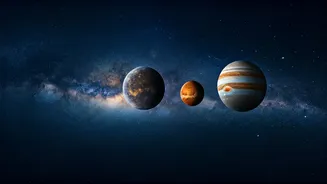


What Exactly Is a Planetary Alignment?
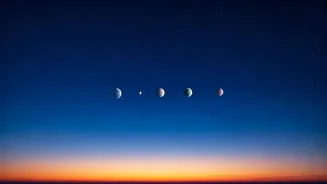
First, let's get one thing straight: the planets aren't actually forming a perfectly straight line in space. A planetary alignment, or conjunction, is an amazing line-of-sight phenomenon from our perspective here on Earth. The planets in our solar system
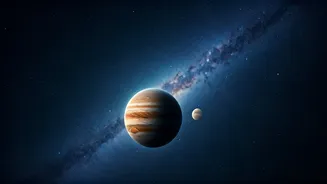
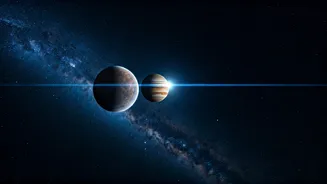
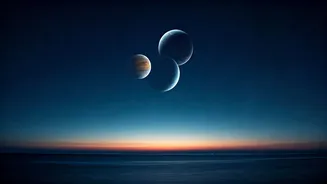
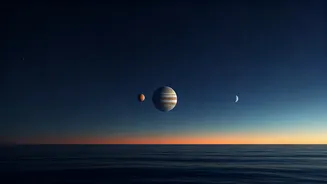
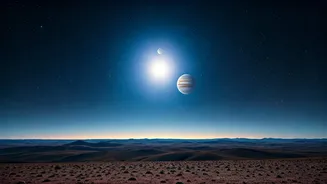
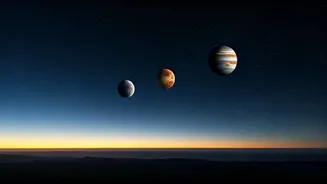
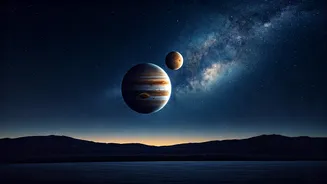
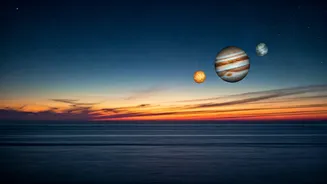
all orbit the Sun on a relatively flat plane, called the ecliptic. Occasionally, several planets appear to gather in a small section of the sky from our viewpoint. It’s like seeing cars on a multi-lane, circular racetrack appearing close together from the stands, even though they're in different lanes and at different distances. Tonight's event brings together the swift messenger Mercury, the dazzlingly bright Venus, and the giant king of planets, Jupiter, in a tight, temporary celestial meeting.
When and Where to Look
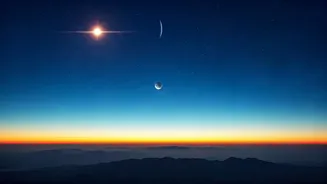
Timing is everything for this event. The best window to view the alignment is shortly after sunset. Look towards the western horizon, the same direction where the Sun just disappeared. You’ll have a relatively short window of about 45 to 60 minutes to see all three planets before they, too, dip below the horizon. The sky needs to be dark enough for the stars and planets to become visible, but not so late that the planets have already set. So, find a spot with an unobstructed view of the west, perhaps a rooftop, a park, or a field away from tall buildings and trees. Be ready to start your sky-watching session about 30 minutes after the official sunset time in your city.
A Simple Guide to Spotting the Planets
You won't have any trouble finding Venus. It will be the brightest 'star' in the sky, a brilliant, unwavering beacon of light. It's often called the 'Evening Star' for this reason. Once you've locked onto Venus, finding the others becomes easier. Jupiter will be the second brightest object in the grouping. While not as intensely bright as Venus, it will still outshine all the actual stars around it. The real challenge, and reward, is spotting Mercury. It’s the faintest of the three and will be positioned closest to the horizon. Because it’s so near the Sun's glare, it’s often difficult to see. But tonight, with Venus and Jupiter as brilliant guideposts, you have your best chance to catch a glimpse of this elusive little planet. They will form a small, visible triangle or a loose line in the twilight sky.
Do You Need a Telescope?
No, you don’t! That's the best part about this particular celestial event. The alignment is perfectly visible to the naked eye. In fact, using a telescope might be counterproductive if you want to see all three planets at once, as its narrow field of view might only capture one planet at a time. However, if you have a pair of binoculars, bring them along. Binoculars are the perfect tool for this occasion. They are powerful enough to make Mercury pop out from the twilight glow and may even reveal Jupiter's four largest moons (known as the Galilean moons) as tiny pinpricks of light flanking the planet. But even with just your eyes, the sight of three planets huddled together is a memorable experience.
Tips for the Best Viewing Experience
To make the most of this cosmic display, a little preparation goes a long way. First, try to get away from city lights. The darker your surroundings, the more vivid the planets will appear against the deepening blue of the twilight sky. Second, give your eyes time to adapt to the darkness. It takes about 15-20 minutes for your pupils to fully dilate, so avoid looking at your bright phone screen while you wait. If you need to use your phone, consider using a stargazing app like SkyView or Star Walk, which can use your phone's camera and GPS to identify exactly what you're looking at. These apps often have a 'night mode' with a red filter to help preserve your night vision. Finally, be patient. Mercury can be tricky to spot, so scan the area near the horizon carefully.