



The Sun’s Volatile Nature
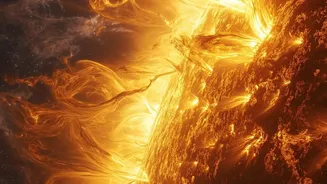
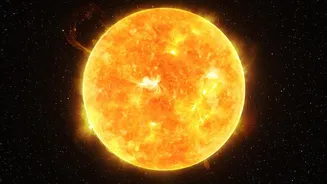
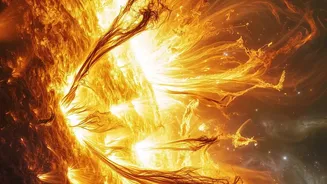
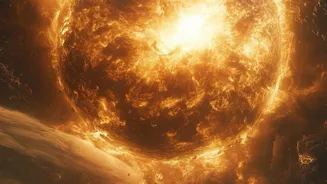
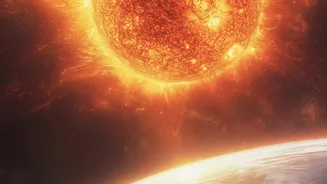
Our Sun, the life-giving star at the center of our solar system, is a dynamic and sometimes violent sphere of hot gas and magnetic fields. It occasionally releases massive bursts of energy and particles into space. These events, known as solar storms,
come in a few forms. Solar flares are intense flashes of radiation that reach Earth in just eight minutes, while Coronal Mass Ejections (CMEs) are colossal clouds of magnetised plasma and particles that travel more slowly, taking one to three days to arrive. While most are harmless, a CME aimed directly at Earth poses a significant threat to our high-tech civilisation. The most famous example, the 1859 Carrington Event, caused telegraph systems worldwide to fail and even deliver electric shocks to operators. A similar storm today could have a far more devastating impact on our deeply interconnected world.
Why Modern Infrastructure is Vulnerable
The danger from solar storms lies in their interaction with Earth's magnetic field. A powerful CME can induce geomagnetically induced currents (GICs) in long conductors on the ground. This is particularly bad news for high-voltage power grids, as these rogue currents can flow into transformers, causing them to overheat, saturate, and potentially fail, leading to widespread and long-lasting blackouts. The 1989 Quebec blackout is a prime example of this vulnerability. Beyond the power grid, our orbital infrastructure is also at risk. Satellites responsible for GPS, telecommunications, and financial transactions can be damaged by high-energy particles, and increased atmospheric drag from a storm can even cause satellites in low orbit to slow down and fail. Radio communications can also be disrupted for hours.
Our Eyes on the Sun
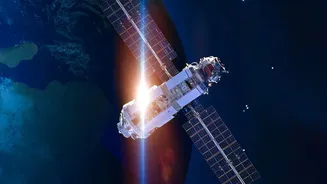
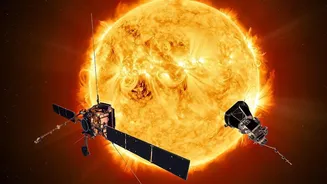
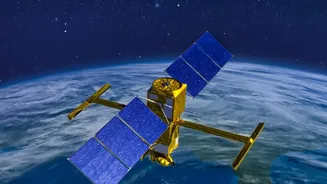
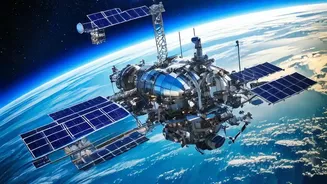
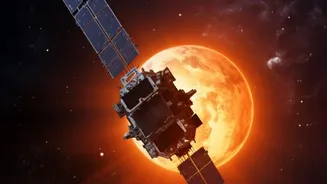
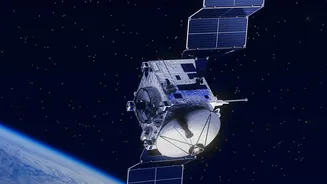
To counter this cosmic threat, a sophisticated network of space- and ground-based sentinels constantly monitors the Sun. The primary agency for this in the United States is NOAA’s Space Weather Prediction Center (SWPC), which works with international partners. A key asset in this network is the Deep Space Climate Observatory (DSCOVR) satellite. Positioned 1.5 million kilometres from Earth at a stable gravity point called L1, DSCOVR acts like a tsunami buoy for space weather. It directly samples the solar wind—the stream of particles constantly flowing from the Sun—and can provide a crucial 15 to 60-minute warning before a CME hits Earth. It succeeded the long-serving Advanced Composition Explorer (ACE) satellite. These space-based assets are complemented by ground-based solar telescopes and observatories around the world that track sunspots and other indicators of solar activity.
From Warning to Protective Action
Receiving an early warning is critical, as it allows infrastructure operators to take protective measures. The SWPC issues a series of watches, warnings, and alerts to notify government agencies and commercial operators. When a significant CME is detected and predicted to impact Earth, power grid operators can take steps to protect their systems. This might involve reducing load on the grid, redirecting power flows to avoid overloading vulnerable transformers, or temporarily taking certain equipment offline. Similarly, satellite operators can command their spacecraft into a protective “safe mode,” shutting down non-essential and sensitive electronics to weather the storm of energetic particles. These preemptive actions are crucial for mitigating the worst potential impacts, preventing catastrophic equipment failure and ensuring services can be restored more quickly after the event passes.
The Future of Space Weather Forecasting
The field of space weather forecasting is constantly advancing. Researchers are developing new AI models, such as the NJIT-developed EarlyDetect and NASA and IBM's Surya model, that can analyse subtle changes in the Sun's magnetic field and acoustic signals to predict the emergence of active regions hours before they become visible. Looking ahead, upcoming missions promise even earlier warnings. ESA's proposed SHIELD mission, and its precursor HENON, aim to place a monitor 10 times farther from Earth than the L1 point, potentially extending the warning time for fast-moving CMEs from minutes to hours. Meanwhile, NOAA's new Space Weather Follow-On (SWFO-L1) satellite, which launched in 2025, is set to become the first operational observatory fully dedicated to these observations, ensuring the continuity of this vital data stream.