


A Fleeting Window of Opportunity
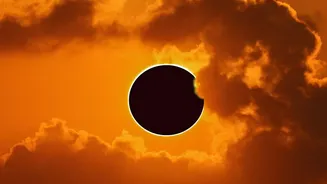
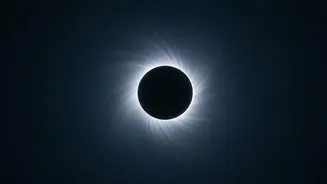
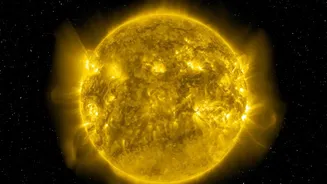
A total solar eclipse is more than just a breathtaking spectacle; it is a fleeting scientific opportunity. The Sun's surface, or photosphere, is so blindingly bright that it completely washes out the much fainter corona, which stretches millions of kilometres
into space. Only when the Moon acts as a natural screen can astronomers on the ground observe this ethereal region in detail. These brief moments of totality are crucial for testing theories and models that are otherwise difficult to verify. Each eclipse provides a unique snapshot, as the Sun's activity is constantly changing, meaning every event offers a chance to see something new.
The Sun’s Lingering Mysteries
Scientists focused their instruments on the corona to tackle some of the most persistent puzzles in solar physics. Chief among them is the coronal heating problem: why is the corona hundreds of times hotter than the Sun's visible surface below it? The corona sizzles at over a million degrees Celsius, while the surface is a comparatively cool 5,500 degrees. Researchers believe the Sun’s complex magnetic fields play a key role in this superheating, and eclipses allow them to measure these fields and observe the plasma structures they create. Another key area of study is the origin of the solar wind, the stream of charged particles that flows from the corona and travels across the solar system, influencing everything from space weather to satellites in Earth's orbit.
An Arsenal of Earth and Space-Based Tools
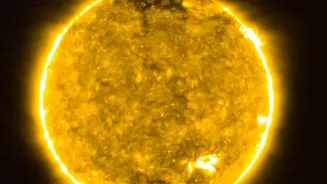
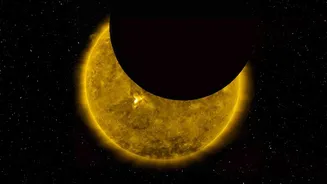
To maximize the brief viewing window, research teams deployed a variety of advanced instruments. NASA's high-altitude WB-57 aircraft flew along the eclipse path, chasing the Moon's shadow to extend its observation time. From its vantage point high above the clouds, a suite of cameras captured high-resolution images of the corona in multiple wavelengths, aiming to understand its structure and how material is ejected into space. On the ground in Iceland and Spain, teams launched dozens of scientific balloons to study how the sudden drop in sunlight affected Earth's atmosphere. Simultaneously, spacecraft like the European Space Agency's Solar Orbiter observed the Sun, providing data from a different vantage point that helps build a 3D picture of the corona. Scientists used data from these missions in the days leading up to the event to predict what the corona would look like, forecasting complex, petal-like structures.
First Light on New Data
While it will take months, if not years, to fully analyze the torrent of data collected, some interesting observations have already emerged. In Spain, some observers witnessed an unusual golden-hued corona. This was attributed to the Sun's low position in the sky during totality and smoke from nearby wildfires, which scattered blue light and gave the corona a spectacular, warm tint. Despite this atmospheric effect, a bright pink solar prominence—a huge loop of gas extending from the Sun—remained clearly visible. The data gathered by high-altitude jets and ground telescopes will now be meticulously studied to refine our understanding of the corona's temperature, composition, and magnetic properties. By comparing these direct observations with models generated before the eclipse, scientists can test and improve their ability to forecast the Sun's behavior.