




Understanding the Shukrayaan Mission
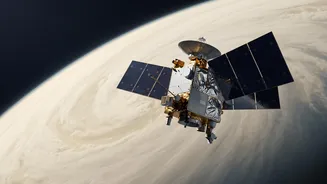
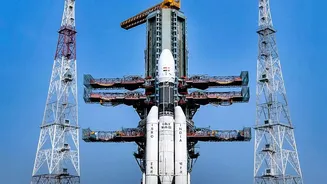
Shukrayaan-1, India's first dedicated mission to Venus, represents a major leap in the nation's interplanetary exploration goals. Formally approved by the Indian government in September 2024, the mission is scheduled for a March 2028 launch aboard the powerful
LVM-3 rocket. After a journey of approximately 112 days, the orbiter is expected to enter a highly elliptical orbit around Venus. The primary goals are to study the planet's surface and subsurface, analyze its atmospheric chemistry, and investigate the interaction between Venus and the solar wind. With this mission, ISRO builds upon the legacy of its successful Mars Orbiter Mission (Mangalyaan), aiming to place India among the elite group of space agencies that have closely studied our mysterious planetary neighbour.
Venus: A Laboratory for Climate Change
Often called Earth's twin due to its similar size and mass, Venus is a world of stark contrasts. It is the hottest planet in our solar system, with a crushing surface pressure and a toxic atmosphere composed mainly of carbon dioxide and shrouded in thick clouds of sulfuric acid. Scientists believe Venus may have once been more like Earth, possibly with liquid water, but suffered a runaway greenhouse effect. Understanding how and why Venus evolved so differently provides a crucial natural laboratory for studying climate change dynamics. By analyzing its extreme atmospheric conditions, scientists hope to gain valuable insights into the processes that can alter a planet's environment, offering a glimpse into potential long-term scenarios for Earth.
The Specialized Toolkit for a Hostile Atmosphere
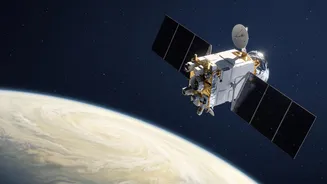
To peer through the dense Venusian clouds, Shukrayaan will be equipped with a suite of around 19 advanced scientific instruments, weighing approximately 100 kilograms. These include contributions from international partners like Russia, France, and Sweden. A key instrument for studying atmospheric dynamics is the Venus Infrared Atmospheric Gases Linker (VIRAL), designed to analyze the composition of the atmosphere. Another is the Venus Thermal Camera (VTC), which will map thermal emissions from the cloud tops to understand atmospheric movement. Additionally, the Swedish-contributed Venusian Neutrals Analyser (VNA) will study how solar wind particles interact with and strip away atmospheric gases, a process crucial for understanding how Venus may have lost its water.
What the Sensors Will Search For
The sensors aboard Shukrayaan are tasked with a detailed investigation of the Venusian atmosphere. They will measure the distribution of key gases like carbon dioxide and sulfuric acid to better model the planet's extreme greenhouse effect. The mission will also search for more elusive molecules. Following the contested discovery of phosphine gas—a potential biomarker—in the clouds of Venus, Shukrayaan's instruments will have the capability to hunt for this and other trace gases. The orbiter will also carry a Retarding Potential Analyzer (RPA) to measure ion density, temperature, and composition, providing a systematic understanding of the Venusian ionosphere and its interaction with the Sun. This data will help scientists create a global map of atmospheric phenomena, including winds and chemical abundances.
Beyond the Atmosphere
While atmospheric study is a critical component, Shukrayaan's objectives extend to the planet's surface and below. The orbiter's flagship instrument is a high-resolution Synthetic Aperture Radar (SAR), which can penetrate the thick cloud cover to map the terrain. This radar is expected to have a significantly higher resolution than that of NASA's Magellan orbiter from the 1990s. The mission will investigate surface geology, look for signs of active volcanic hotspots, and map lava flows. For the first time, a ground-penetrating radar will also be used to study the subsurface structure of Venus, offering unprecedented insights into the planet's geological history. The mission will also serve as a technology demonstrator for ISRO, notably through the use of aerobraking to adjust the spacecraft's orbit.