



A New Look at a Familiar Neighbor
Located about 11 to 13 million light-years away, Centaurus A has long been a source of fascination for astronomers. It’s known for its peculiar shape and a prominent dark dust lane that slices across its bright center, the visible scars of a dramatic
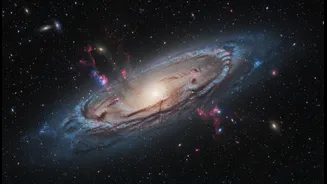
past. Scientists theorize that Centaurus A is the result of a colossal collision between a large elliptical galaxy and a smaller spiral galaxy that took place roughly two billion years ago. This ancient merger made it an incredibly active place, setting the stage for intense star formation and fueling a supermassive black hole at its core. While telescopes like Hubble gave us glimpses, they were blocked by the galaxy's thick dust. Now, Webb’s powerful infrared vision has pierced that dusty veil, revealing the galaxy’s hidden heart in unprecedented detail.
Seeing Through the Dust with Infrared
The key to this new view is Webb’s ability to see in near- and mid-infrared light. These wavelengths can pass through the dense clouds of cosmic dust that obscure visible light. Where previous infrared observatories like the Spitzer Space Telescope could see large-scale structures, they lacked the sharpness to resolve fine details. Webb, however, delivers both clarity and depth. What once appeared as a hazy glow is now resolved into a densely packed field of millions of individual stars. This incredible resolution allows astronomers to perform what they call 'galactic archaeology.' By studying different generations of stars, they can reconstruct a timeline of the galaxy's turbulent history—from its initial formation to the burst of star birth triggered by the collision.
The Violent Engine at the Center
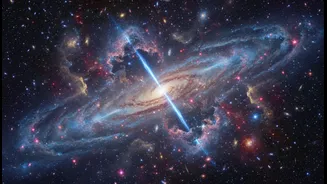
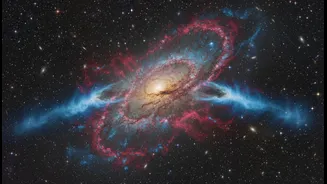
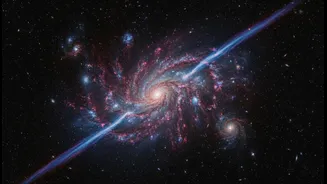
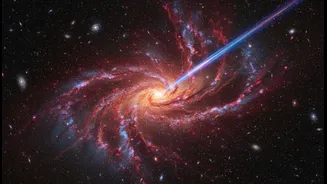
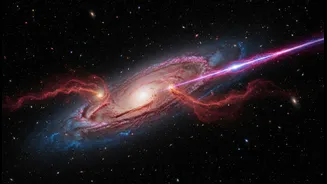
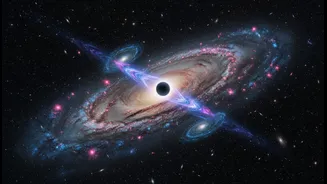
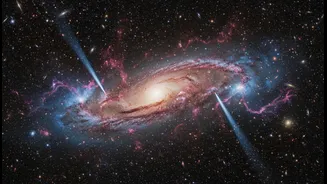
At the heart of Centaurus A lies a supermassive black hole actively feeding on the gas and dust supplied by the galactic merger. As it consumes this material, the black hole launches powerful, high-speed jets of plasma and releases enormous amounts of energy, which in turn shapes the entire galaxy. The new Webb image reveals several processes at play. It shows warm hydrogen gas rotating near the black hole, while other gas is being rapidly pushed outward by its activity. This offers new clues into a long-standing cosmic puzzle: how black holes can both trigger intense star formation by compressing gas, and also shut it down by blasting away the raw materials needed for new stars to be born.
Weaving a Complete Picture
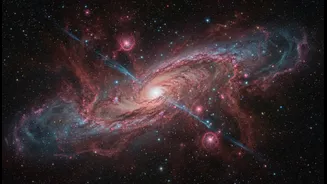
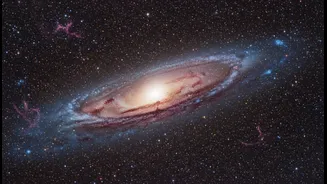
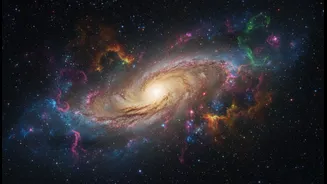
This single, dramatic image combines multiple cosmic processes into one cohesive view. It simultaneously shows the aftermath of the ancient collision in the form of a warped, parallelogram-like disk of dust and gas. It reveals the ongoing activity of the central supermassive black hole and its influence on the surrounding environment. And it pinpoints the locations of stellar nurseries, seen as glowing red points where new stars are forming from recycled dust shed by older stars. Astronomers were also surprised by mysterious features, like a faint 'S' shaped structure near the core, whose origins are not yet understood but are likely linked to the collision or the black hole's jets. By capturing the interplay between the galaxy's past and present, Webb provides a vivid record of how galaxies evolve.