




A Landmark Discovery
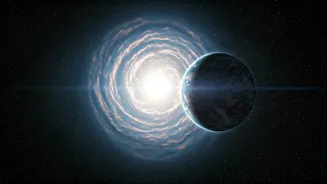
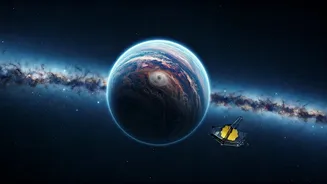
In what is being hailed as a landmark moment for astronomy, scientists have detected definitive signs of water vapour in the atmosphere of an exoplanet known as GJ 9827d. Located 97 light-years away, this planet is the smallest world to date where water has
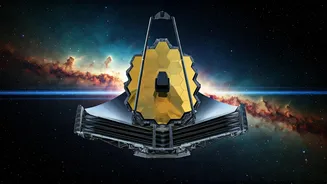
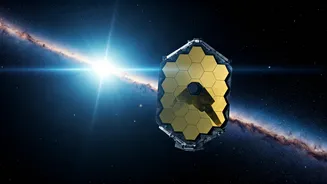
been confirmed. The discovery, made possible by the incredible power of the James Webb Space Telescope (JWST), pushes us closer to understanding the variety of planets in our galaxy and identifying worlds that might have the right conditions for life. While GJ 9827d was first spotted in 2017, it took the advanced infrared capabilities of the JWST to finally analyse its atmosphere and uncover its secrets.
How Do You Find Water Light-Years Away?
Detecting anything across such a vast distance sounds like science fiction, but the method is remarkably clever. It's called transit spectroscopy. Scientists wait for the exoplanet to pass in front of its host star, an event known as a 'transit'. As the starlight streams through the planet's thin atmospheric layer, some of it is absorbed by the molecules present. Every molecule, including water (H2O), absorbs light at a very specific set of wavelengths, creating a unique chemical 'fingerprint'. The JWST acts like a giant prism, splitting the starlight into its full spectrum. By looking for the missing slivers of light, astronomers can deduce exactly which gases are in the planet's atmosphere, even from 97 light-years away.
Just Water Vapour, Not Oceans
It's crucial to manage expectations. Finding water vapour in the atmosphere is not the same as finding flowing liquid oceans on the surface. GJ 9827d is extremely hot, with a surface temperature estimated to be around 425 degrees Celsius, similar to Venus. At these temperatures, any water would exist as a superheated steam. If the atmosphere is predominantly water, the planet would be an inhospitable, steamy world. There are two leading theories: it could be a 'mini-Neptune' with a puffy, hydrogen-rich atmosphere that contains some water, or it could be a warmer version of Jupiter's moon Europa, a rocky body with a very thick, water-rich atmosphere on top. Either way, it's not a tropical paradise.
More Than Just Water
While finding water is exciting, it's just the first step in the search for habitable worlds. Water is a 'precursor' for life as we know it, but it's not a sign of life by itself. Scientists are now hunting for a combination of gases known as biosignatures. On another promising exoplanet, K2-18 b, the JWST has also detected methane and carbon dioxide. There was even a tantalising, though unconfirmed, hint of dimethyl sulfide (DMS) — a gas that, on Earth, is overwhelmingly produced by marine life like phytoplankton. Finding a cocktail of such gases together would be a much stronger indicator that biological processes might be at play. The detection of water on GJ 9827d proves the technology works, paving the way for these more complex investigations.
The Road Ahead
This discovery is a technological triumph and a critical stepping stone. It proves that the JWST can successfully probe the atmospheres of smaller, potentially rocky planets, not just the gas giants that were easier to study before. Future observations of GJ 9827d will aim to determine the atmosphere's full composition. Is it mostly water, or just a hydrogen-helium mix with a bit of moisture? Answering that will help scientists understand how such planets form and evolve. Each new piece of data refines our models and brings us closer to answering the ultimate question: are we alone in the universe? This is not the final answer, but it is a major and thrilling new chapter in the search.