







The Coveted Lower Berth
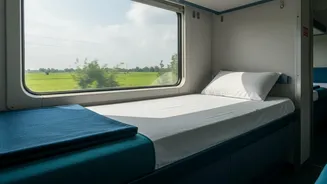
The Lower Berth (LB) is often the most sought-after, especially by senior citizens and families with children. Its main advantage is accessibility; there's no need to climb, making it ideal for those with mobility issues or anyone who anticipates frequent
trips to the washroom. It also doubles as the default seating area for all three passengers in the bay during the day and usually offers a direct window view. However, this popularity comes with a downside. You'll have the least privacy, as your co-passengers will sit on your space until the official sleeping time (10 pm to 6 am). This can be disruptive if you're looking for a quiet daytime nap.
The Compromise of the Middle Berth
The Middle Berth (MB) is a classic compromise, positioned between the other two. During the day, it's folded against the coach wall, allowing passengers to use the lower berth for seating. At night, it’s unfolded into a sleeping bunk. The main drawback is the lack of headroom; it’s impossible to sit up straight, making it feel cramped for some. Its use is also restricted to night hours, so you can't decide to have a lie-down in the middle of the afternoon. Getting in and out requires a bit of a climb, but it offers more seclusion from the constant movement in the aisle compared to the lower berth.
The Seclusion of the Upper Berth
For travellers who prize privacy and uninterrupted sleep, the Upper Berth (UB) is often the best choice. Once you're up there, the space is yours for the entire journey. You can sleep whenever you like without waiting for others. It also offers a sense of security for your luggage, which can be tucked away beside you. The cons are significant for some: it requires climbing a ladder, which can be inconvenient, and you have no window view. The space can also be tight, with less headroom than even the middle berth in some modern coaches.
The Unique Case of Side Berths
On the other side of the aisle are two more berths: the Side Lower (SL) and Side Upper (SU). These run parallel to the direction of the train. The Side Lower is a window-lover's dream, converting from two seats into a single berth. However, it's often narrower than the main berths and is exposed to constant foot traffic in the aisle. During the day, it becomes a shared seat with the Side Upper passenger. The Side Upper, meanwhile, is often hailed by solo travellers as the best of both worlds. It offers the privacy of an upper berth but with more headroom, allowing most people to sit up comfortably. You can sleep anytime without being disturbed, but you still need to be comfortable with climbing.
Location Within the Coach Matters
Beyond the berth type, its location within the coach can significantly impact your journey. Berths located near the toilets or the main doors of the coach experience more traffic, noise, and sometimes unpleasant smells. People congregate in these areas, doors open and close at every station, and the clatter can be constant. For a more peaceful journey with fewer disturbances, try to select a berth closer to the middle of the coach. These seats tend to experience less foot traffic and are generally quieter, away from the hustle and bustle of the coach ends. They may also offer a smoother ride with less jerking motion.
How to Make Your Preference Known
When booking your ticket on the IRCTC website or app, you are given the option to state your berth preference. You can choose from options like 'Lower', 'Upper', 'Side Lower', etc. While this doesn't guarantee you'll get your first choice, the system does take it into account based on availability, age, and other factors. For those for whom a lower berth is a necessity, there's a specific option: "Book only if at least one lower berth is allotted." Selecting this will ensure your ticket is only booked if the system can assign you a lower berth, though it might mean forgoing the ticket if none are available.