





From Ambition to Orbit
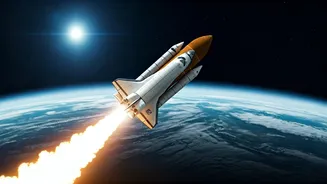
First announced in 2018, the Gaganyaan project is the Indian Space Research Organisation's (ISRO) ambitious endeavour to demonstrate human spaceflight capability. The goal is to launch a crew of three astronauts into a Low Earth Orbit of 400 kilometres,
keep them there for a three-day mission, and bring them back safely to Earth with a splashdown in Indian waters. Achieving this will make India only the fourth nation in the world—after the US, Russia, and China—to possess independent human spaceflight capabilities, a monumental achievement for the country's scientific and technological prowess.
What 'Test Mode' Really Means
Moving into "test mode" signifies a shift from design and theory to intense, real-world validation. Before astronauts, or 'Vyomanauts', can board the spacecraft, every system must be proven to be safe and reliable. ISRO is conducting a series of precursor missions to verify the readiness of its technology. These include Integrated Air Drop Tests (IADT), Pad Abort Tests (PAT), and Test Vehicle (TV) flights. The entire process is methodical, with safety as the paramount concern. Over 8,000 ground and structural tests have already been completed to ensure the integrity of the vehicle and its systems.
Testing the Lifeline: Parachutes and Engines
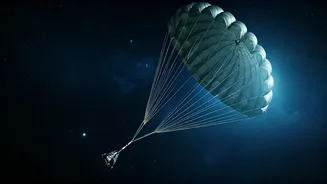
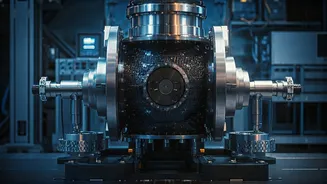
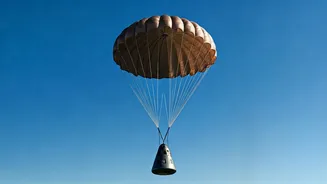
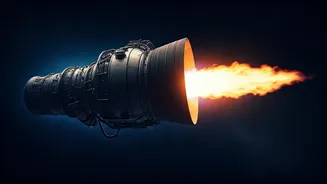
Two of the most critical systems are the engines that power the mission and the parachutes that ensure a safe return. ISRO has successfully completed extensive testing of the human-rated Vikas engines, which will power the LVM3 rocket carrying the crew. These tests involved long-duration hot firings to simulate flight conditions. Simultaneously, a series of Integrated Air Drop Tests have been conducted to validate the complex parachute system. In these tests, a simulated Crew Module is dropped from a helicopter to ensure the ten parachutes deploy in their precise sequence, slowing the capsule for a gentle splashdown. Recent tests in 2026 successfully validated the parachute system's performance, marking a significant step towards mission readiness.
The Human-Rated Rocket and Crew Module
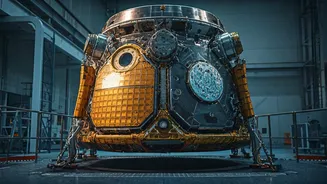
The launch vehicle for Gaganyaan is a specially modified version of ISRO's heaviest and most reliable rocket, the LVM3, which has been 'human-rated' for this mission. This involves re-configuring its systems to meet stringent safety and reliability standards. A key feature is the Crew Escape System, which can quickly propel the Crew Module to safety in case of an emergency during launch. The Crew Module itself, where the astronauts will reside, is a marvel of engineering, equipped with a life support system to provide an Earth-like environment in space. Its propulsion system, crucial for control during re-entry, has also undergone successful hot tests.
The Road Ahead: Uncrewed Flights First
Before the first historic crewed flight, ISRO has planned a series of uncrewed missions. The first of these, G1, is scheduled for 2026. This flight will carry Vyommitra, a humanoid robot, to simulate human functions and test the life support and control systems. Following G1, at least two more uncrewed flights (G2 and G3) are planned to thoroughly test the rocket's performance and the capsule's re-entry and recovery procedures. This multi-stage validation process ensures every aspect of the mission is perfected. The first crewed mission, H1, is now anticipated in 2027 or 2028, reflecting a cautious and safety-first approach.