
A New Window to Cosmic Dawn
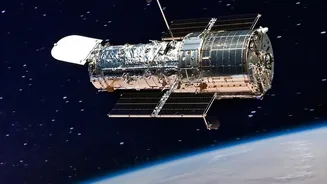
The source of this excitement is the flood of data coming from advanced observatories, most notably the James Webb Space Telescope (JWST). Its power lies in its ability to see in infrared light. When we look at the most distant galaxies, we are also looking
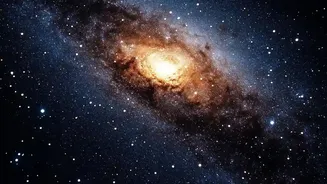
back in time, as the light from them has taken billions of years to reach us. The universe's expansion stretches this light into longer, redder wavelengths, a phenomenon called redshift. JWST is specifically designed to capture this faint, ancient light, allowing us to see galaxies as they were in the universe's infancy, just a few hundred million years after the Big Bang. These aren't just prettier pictures; they are a fundamentally new way of seeing the cosmos, cutting through cosmic dust that once obscured our view and revealing the universe's formative years in stunning detail.
Finding Mature Galaxies in an Infant Universe
One of the most startling discoveries is finding galaxies in the early universe that are far more developed than models predicted. Astronomers expected the first galaxies to be small, chaotic, and messy. Instead, JWST has found surprisingly large, well-structured, and chemically complex galaxies from a time when the universe was less than a billion years old. Some of these ancient galaxies already contain elements like oxygen and nitrogen, which are forged inside stars and distributed when they die. Finding them this early suggests that the cycle of star birth and death got going much faster and more efficiently than previously thought. This is forcing a major rethink of the timelines for galaxy formation, as the real universe seems to have been in a hurry to build complex structures.
Rewriting the Rules of Galaxy Mergers
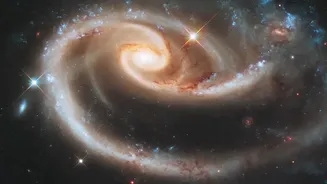
For decades, a leading theory was that major galaxy mergers were a primary way to shut down star formation. The idea was that a collision would trigger a powerful quasar at the galaxy's centre, which would then blast away or heat the cold gas needed to form new stars. This process is known as 'quenching'. However, recent high-resolution images from JWST and advanced computer simulations like IllustrisTNG are challenging this notion. New studies analysing thousands of simulated galaxies show that the vast majority of galaxies that undergo mergers, both major and minor, continue to form stars. It seems that mergers by themselves are not enough to cause quenching, suggesting the process of how galaxies live and die is far more complicated. Other factors, like how a supermassive black hole feeds, are now being investigated with renewed focus.
Galactic Archaeology Close to Home
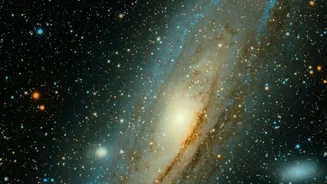
The new high-resolution capabilities are not just for distant galaxies; they're also being used for a kind of cosmic archaeology on our cosmic neighbours and even our own Milky Way. By resolving individual stars in nearby galaxies like Centaurus A, astronomers can read the galaxy's history. Each star's position and properties hold clues about past events, such as a dramatic collision with another galaxy billions of years ago. In another recent discovery, new data has helped confirm a theory that our own Milky Way galaxy likely underwent a massive 'disc flip' more than 90 degrees in its distant past, following a head-on collision with another galaxy. This event helps explain some of the strange, counter-rotating collections of stars we see today. These detailed images allow us to reconstruct galactic history, star by star.