

The Science of the Overcooked Edge
The core reason for this annoying phenomenon is simple geometry and heat transfer. The edges and corners of any piece of food have more surface area exposed to heat compared to the protected centre. Heat attacks from multiple sides, causing moisture at the periphery
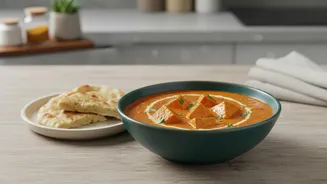
to evaporate much faster. Think of it like a battle: the edges are the front lines, taking the brunt of the heat from the hot air (convection), the pan (conduction), and the heating element itself (radiation). The inside of the food, meanwhile, is insulated by the outer layers and cooks more slowly as heat gradually travels inward. This effect is why the corner piece of a lasagne or a tray of brownies is always the crispiest. For foods like paneer or chicken, this rapid moisture loss tightens the protein structure, resulting in that dreaded tough, rubbery texture.
Solution 1: Create an Even Playing Field
Since thinner parts cook faster, the most effective strategy is to make the food a uniform thickness. For a chicken breast, which is often plump in the middle and tapered at the ends, this means pounding it out. Place the chicken between two sheets of plastic wrap and gently pound it with a rolling pin or meat mallet until it's an even thickness all over. For paneer, try to cut your blocks into uniform cubes or slabs. With steaks or other cuts of meat, slicing them thinly and uniformly is key for quick, even cooking in stir-fries. A trick for achieving super-thin slices is to partially freeze the meat for about 30-60 minutes; the firmness allows for more precise cuts.
Solution 2: Build a Moisture Barrier
If the problem is moisture loss, the solution is to give the food more moisture to begin with. This is where brining and marinating come in. Soaking meat like chicken or fish in a simple saltwater solution (a brine) for as little as 30 minutes helps it absorb and retain water during cooking, creating a juicy result. Marinades, especially those with acidic components like yoghurt or citrus, also tenderise and add moisture. For paneer, a common complaint is that it becomes hard and chewy. A simple fix is to soak the cubes in warm water for 15-20 minutes before cooking. This rehydrates the paneer and relaxes its protein structure, ensuring it stays soft even after being added to a hot gravy or pan.
Solution 3: Manage the Heat Zone
Controlling where the heat is most intense can also prevent dry edges. For pan-searing, this means not overheating the pan. For grilling or roasting, create two-zone heating. Bank your coals to one side of the grill or set your oven burners to create a hot side and a cooler side. You can start by searing the food on the hot side to develop flavour and a crust, then move it to the cooler side to finish cooking gently with indirect heat. For baked goods like pies or cakes, which are notorious for having dry, over-baked edges, you can shield them. Loosely wrapping the edges of a pie crust with a strip of aluminium foil for the first part of baking will deflect the intense heat, allowing the centre to catch up. There are even special silicone cake strips you can soak and wrap around your cake pans to ensure the sides bake more gently.
Solution 4: The Post-Cook Rest
The cooking process doesn't end the moment you take food off the heat. When meat is cooked, its muscle fibres tense up and push juices toward the centre. If you slice into it immediately, all that flavourful liquid will spill out onto your cutting board. Allowing the meat to rest for 5-10 minutes is crucial. During this time, the fibres relax and reabsorb the juices, distributing them throughout the cut. This means the edges, which may have lost some moisture, will get a chance to rehydrate from within, resulting in a more tender and flavourful bite from end to end.