





The Unsung Hero of Exploration
When a mission successfully lands a rover on Mars or flies through the plumes of an icy moon, the world celebrates a monumental achievement. What often gets lost in the headlines, however, is the foundational miracle that makes it all possible: knowing
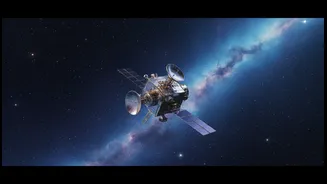
exactly where that spacecraft is, where it's going, and how to steer it. This is the domain of precision navigation. It's the art and science of piloting a vessel across millions of kilometres of empty space to arrive at a moving target, at a precise time, often with an accuracy that defies comprehension. Forget the GPS on your phone; deep space navigation is a different beast entirely. There are no satellite constellations to ping. Instead, it relies on a sophisticated system of techniques, primarily managed by networks on the ground like NASA's Deep Space Network (DSN). This global array of giant radio antennas sends and receives signals to measure a spacecraft's distance, speed, and direction, forming the backbone of our conversations with the cosmos.
Hitting a Cosmic Bullseye
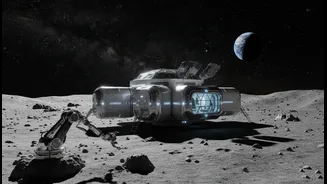
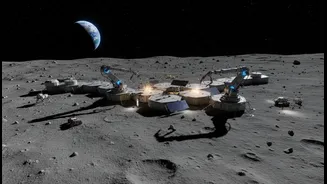
The challenges are immense. Light (and thus, radio signals) can take minutes or hours to travel from Earth to a distant probe. This means commands can't be executed in real-time; every manoeuvre must be planned far in advance based on complex orbital mechanics. Navigators use techniques like Doppler shifts—measuring changes in the frequency of radio waves—to calculate a spacecraft's velocity with incredible accuracy. They use ranging to time how long a signal takes to make a round trip, revealing its distance. For a mission like the Artemis program returning humans to the Moon, or a complex multi-stage journey like Mars Sample Return, there is virtually no margin for error. These missions require navigating to specific orbits, landing on designated patches of ground, and orchestrating robotic handoffs millions of miles away, all while every object involved is hurtling through space.
Beyond the Ground Stations
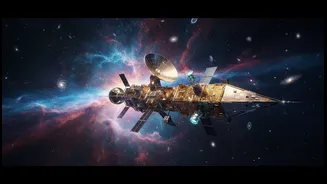
While the DSN is a workhorse, the future of space exploration demands ever greater autonomy and precision, pushing engineers to develop new methods. One exciting frontier is autonomous navigation, where the spacecraft itself does much of the work. Optical navigation, for example, allows a probe to take images of nearby moons or asteroids against a background of stars to calculate its own position, a technique proven on missions like Deep Space 1. Another futuristic technology being tested is X-ray pulsar navigation (XNAV). Pulsars are dense, spinning stellar remnants that emit beams of radiation with the regularity of an atomic clock. By detecting the signals from several of these 'cosmic lighthouses', a spacecraft could theoretically navigate anywhere in the solar system without phoning home.
Lost in Technical Translation
So why don't we hear more about this? The simple answer is that navigation is hard to visualize and even harder to explain. A rocket launch is visually spectacular. A new photo of Jupiter is awe-inspiring. The process of sending and receiving radio signals and running calculations doesn't offer the same immediate thrill. Often, details about navigation are buried deep within technical press kits or scientific papers, presented in language that is inaccessible to a non-expert audience. This creates a communication gap. Space agencies and science communicators excel at sharing the 'what'—the discoveries and the images—but often struggle to convey the 'how'. Yet, understanding the 'how' is crucial for a deeper appreciation of the entire enterprise.
Charting a Clearer Course
For students considering careers in STEM, for space enthusiasts who follow every mission, and for the general public whose support funds this exploration, this is a missed opportunity. Better guidance on navigation isn't about dumbing down the science; it's about finding better analogies, creating clearer visualizations, and dedicating more resources to explaining the process. It's about telling the human story of the brilliant navigators who guide our robotic emissaries. Showing how a mission like LuGRE aims to use GPS-like signals even at the Moon can make the concept relatable. Explaining that scientists are building a 'cosmic GPS' using pulsars can capture the imagination. By not telling these stories, we fail to communicate one of the most intellectually thrilling aspects of spaceflight.