



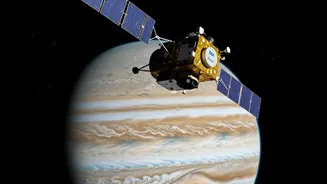
An Interplanetary Voyager
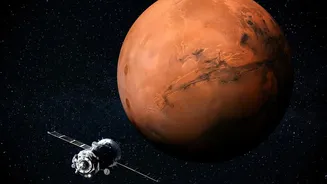
The Europa Clipper isn't just a plan; it's a reality in motion. Having launched in October 2024, the spacecraft is now on a multi-year, 2.9-billion-kilometre voyage across the solar system. As of late 2026, it has already used Mars for a gravitational
slingshot and is now cruising towards a flyby of Earth in December 2026 to gain even more speed. This massive spacecraft, with a wingspan the size of a basketball court, is the largest interplanetary vehicle NASA has ever built. It carries a sophisticated suite of nine scientific instruments shielded in a titanium vault to protect them from Jupiter's harsh radiation. Its destination is not just Jupiter, but a specific moon that has captivated scientists for decades: Europa.
Why All Eyes Are on Europa
So, why travel all that way for one moon? Europa is considered one of the most promising places in our solar system to find the conditions suitable for life beyond Earth. The primary reason is the overwhelming evidence that a vast, salty liquid water ocean exists beneath its icy shell. Scientists believe this ocean could contain double the amount of water found in all of Earth's oceans combined. Data from past missions like Galileo showed that Europa interacts with Jupiter's magnetic field in a way that suggests a global, conductive layer, like saltwater. Add to this a rocky seafloor that could host hydrothermal vents — similar to those on Earth that teem with life — and you have the three key ingredients for life as we know it: liquid water, the right chemical elements, and a source of energy.
A Toolkit for Uncovering Secrets
Europa Clipper isn't designed to find life directly, but to determine if the moon is 'habitable'. To do this, it will act as a flying laboratory. Its ice-penetrating radar will scan deep into the frozen crust, measuring its thickness and searching for the definitive boundary of the ocean below. A powerful magnetometer will measure the ocean's depth and even its saltiness. High-resolution cameras will map nearly the entire surface in incredible detail, far surpassing previous images and helping scientists identify geologically active areas. Perhaps most excitingly, instruments called mass spectrometers will be able to 'taste' the moon's incredibly thin atmosphere and any water plumes that may be erupting into space, analyzing them for complex organic molecules. These plumes could offer a direct sample of the ocean without ever having to drill through the ice.
A Long Journey and a Patient Search
Patience is a virtue in deep space exploration. Europa Clipper won't arrive in orbit around Jupiter until April 2030. From there, it won’t orbit Europa directly, as the moon sits deep within Jupiter’s punishing radiation belts. Instead, the spacecraft will make long, looping orbits around Jupiter, diving in for a close flyby of Europa before retreating to safety. Over about three and a half years, it will perform 49 of these close passes, some as low as 25 kilometres above the surface, allowing it to survey different regions of the moon with each pass. This clever orbital dance ensures the spacecraft can gather a global dataset while protecting its sensitive electronics from damage.