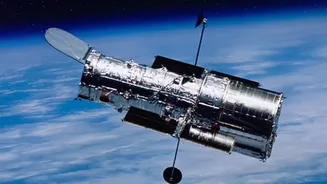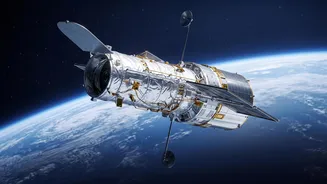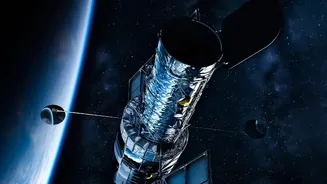





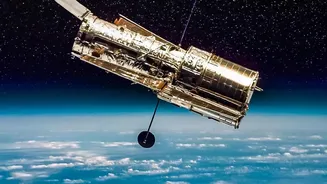
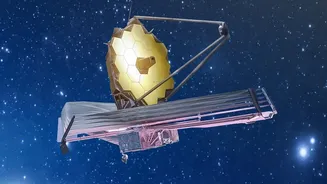
For over 35 years, the Hubble Space Telescope has been humanity's eye on the cosmos. Now, as its orbit slowly decays, NASA has made a pivotal move, asking the commercial space industry for ideas to save this legendary scientific asset.
A Slow But Steady Descent
Like every object
in low Earth orbit, the Hubble Space Telescope is subject to faint atmospheric drag, which causes it to gradually lose altitude. Launched in 1990 to an orbit of about 612 kilometers, it now circles the Earth at an altitude well below 500 kilometers. Without an engine of its own to counteract this decay, its orbit will continue to shrink until it makes a fiery reentry into the atmosphere. Current projections estimate this will happen between 2033 and 2034 if no action is taken. While its scientific instruments remain highly productive despite some aging components like gyroscopes, the external threat of orbital decay is now the primary limiting factor on its lifespan. This makes the prospect of a reboost not just a rescue mission, but a logical step to preserve a valuable asset that is still delivering groundbreaking science.
NASA's Call for Commercial Solutions
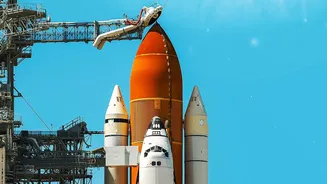
Recognizing the urgency, NASA issued a formal Request for Information (RFI) on October 29, 2026, inviting private companies to propose solutions. This isn't a contract, but a market survey to understand what the rapidly evolving commercial sector can offer. The RFI outlines three main possibilities: a 'reboost' mission to push Hubble into a higher, more stable orbit; a more complex servicing mission to potentially upgrade its systems; or a controlled deorbit to ensure it comes down safely over an unpopulated area. Responses are due by November 30, 2026, and any potential mission would likely need to fly by 2032 to be effective. This move signals a significant shift from the past, when Hubble was serviced exclusively by NASA's own Space Shuttle fleet, which was retired in 2011.
Who Could Answer the Call?
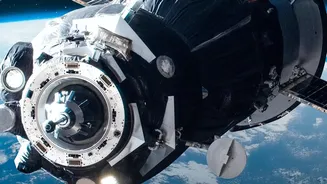
The most prominent name linked to a potential Hubble mission is SpaceX, in partnership with the Polaris Program led by billionaire and current NASA Administrator Jared Isaacman. In 2022, they signed an unfunded agreement with NASA to study the feasibility of using a Crew Dragon capsule for a reboost mission, an idea that was explored but not pursued at the time. With Isaacman now leading the agency, the idea has resurfaced with a broader call to the entire industry. Other companies in the emerging field of in-space servicing, such as Astroscale and Northrop Grumman, which have developed robotic mission extension vehicles, could also present viable proposals. The RFI opens the door for both crewed and robotic solutions, leaving it to the industry to pitch the most innovative and cost-effective plans.
A New Era of Spacekeeping
This request from NASA is more than just an attempt to save a single telescope; it represents a new chapter in how space agencies manage long-term assets. The challenge of the failed robotic rescue of the Swift Observatory highlighted the need for proactive servicing solutions before a situation becomes an emergency. A successful commercial mission to Hubble would serve as a powerful proof-of-concept for a new market: extending the lives of valuable satellites. It demonstrates a move away from the disposable model of space hardware toward one of maintenance and sustainability. As Nicky Fox, NASA's Associate Administrator for Science, noted, the commercial industry has evolved rapidly, offering new capabilities for in-space capture and servicing that didn't exist during the shuttle era. This collaboration could pave the way for future missions to service not just scientific observatories, but a wide range of critical infrastructure in orbit.