



An Alien World on Earth
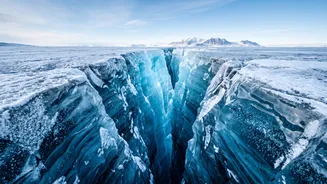
Deep beneath Antarctica's vast ice sheet, which can be up to four kilometers thick, lie hundreds of lakes. These are not frozen bodies but reservoirs of liquid water, kept from freezing by the immense pressure of the ice above and the gentle warmth of the Earth's
geothermal heat from below. Some of these lakes, like the famous Lake Vostok, have been sealed off from the surface and sunlight for millions of years, creating one of the most isolated ecosystems on our planet. This profound isolation, combined with total darkness, extreme cold, and immense pressure, makes these subglacial environments a near-perfect analogue for conditions suspected on distant icy worlds.
The Alluring Europa Connection
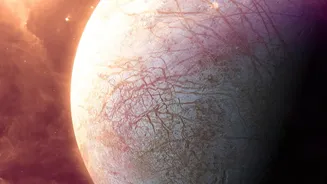
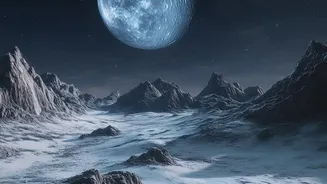
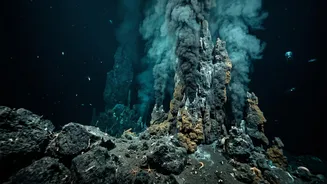
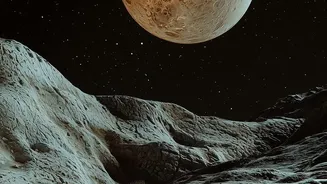
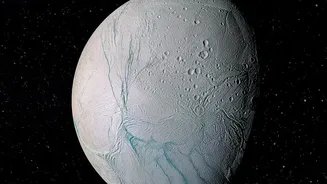
Jupiter's moon Europa is one of the most tantalizing targets in the search for life beyond Earth. Scientists have strong evidence that beneath its cracked, frozen crust lies a global ocean of salty liquid water, potentially containing twice as much water as all of Earth's oceans combined. This hidden ocean is believed to be in contact with a rocky seafloor, creating the potential for hydrothermal vents—springs of hot, chemically rich water that, on Earth, support vibrant ecosystems without any sunlight. The parallels to Antarctica's subglacial lakes are striking: a thick ice shell hiding a liquid water environment from the outside world. This makes Antarctica the best natural laboratory we have for understanding what a mission to Europa might encounter.
If Life Can Exist Here, Maybe It Exists There
The most profound discovery from drilling into these Antarctic lakes is the confirmation of life. In projects that have successfully and cleanly sampled lakes like Whillans and Mercer, scientists have found thriving microbial communities. These are not just dormant cells, but active ecosystems adapted to survive without light, feeding on chemical energy sources from minerals in the rock bed. Finding life in such a hostile, isolated environment on Earth provides a powerful proof-of-concept for astrobiologists. If life can find a way to survive in the dark, cold, high-pressure world of a subglacial Antarctic lake, it strengthens the hypothesis that life could arise and persist in the similar ocean of Europa. In some samples from Lake Mercer, scientists were even surprised to find the preserved carcasses of tiny crustaceans and tardigrades (also known as 'water bears'), suggesting a complex history of transport and life on the continent.
A Dress Rehearsal for Deep Space
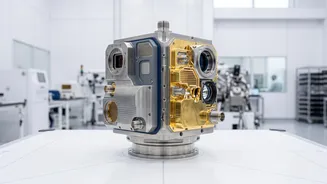
Beyond the biological insights, Antarctica serves as a crucial testing ground for the technology and methods needed for a Europa mission. Drilling through several kilometers of ice without contaminating the pristine environment below is a massive engineering challenge. Projects like the Subglacial Antarctic Lakes Scientific Access (SALSA) have refined techniques using hot-water drills and sterile sampling procedures to ensure the life they find is native to the lake, not brought from the surface. Teams are also testing autonomous underwater vehicles, ice-penetrating radar, and life-detection instruments that must operate in extreme cold and without direct human control—all essential capabilities for a future robotic explorer on Europa.
Informing the Next Generation of Exploration
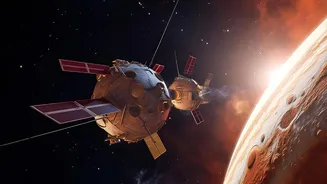
The lessons learned in Antarctica are directly informing upcoming missions. NASA's Europa Clipper, which launched in October 2024 and is set to arrive at Jupiter in 2030, is specifically designed to investigate Europa's habitability. It will conduct dozens of close flybys, using instruments like ice-penetrating radar to confirm the ocean's existence and thickness, and spectrometers to analyze chemicals on the surface that might have welled up from below. While Clipper isn't a life-detection mission itself, its main goal is to identify places below the surface that could support life, paving the way for a future lander. The groundwork laid in Earth's harshest, most alien environment is what makes this ambitious next step in space exploration possible.