





The Spacecraft with Two Lives
The hero of this story is a spacecraft that was never designed for a second mission. Originally named OSIRIS-REx, it launched in 2016 with a singular, ambitious goal: travel to the near-Earth asteroid Bennu, collect a sample, and bring it back. It performed
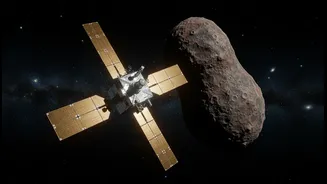
this task flawlessly, traveling hundreds of millions of kilometres, touching down on the asteroid in October 2020, and successfully returning its precious cargo to Earth in September 2023. That sample is now giving scientists an unprecedented look at the building blocks of our solar system. But after dropping off its delivery, mission controllers realised the spacecraft was still healthy and had plenty of fuel left in the tank. Instead of retiring it, NASA gave it a new name and a new destination, transforming OSIRIS-REx into OSIRIS-APEX (short for OSIRIS-APophis EXplorer).
A High-Stakes Slingshot
The latest "high-skill cosmic encounter" refers to a series of finely-tuned orbital adjustments, including several close passes to the Sun and a gravity-assist maneuver using Earth itself. These flybys are essential for adjusting the spacecraft's trajectory with minimal fuel use. By swinging past our planet, OSIRIS-APEX used Earth's gravity like a slingshot to bend its path and accelerate it towards its new target. This maneuver required incredible precision from the navigation team, as the probe needed to hit an exact point in space at a specific time to ensure it would arrive at its destination years from now. This recent event confirms the veteran explorer and its instruments are still in prime condition, ready for the next phase of deep-space exploration.
Destination: The 'God of Chaos' Asteroid
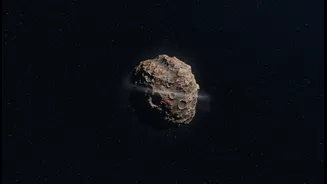
The new target is no ordinary space rock. OSIRIS-APEX is on its way to asteroid 99942 Apophis, named after an ancient Egyptian deity of chaos. Apophis earned its infamous reputation shortly after its discovery when initial calculations suggested a small but concerning possibility of it hitting Earth. While further observations have definitively ruled out any impact for the foreseeable future, Apophis will make a historically close approach to our planet on April 13, 2029. On that day, the 340-metre-wide asteroid will pass within 32,000 kilometres of Earth's surface—closer than the orbits of many geostationary satellites. An encounter this close by an object so large happens only about once every 7,500 years.
A Unique Scientific Opportunity
The 2029 flyby presents a once-in-a-lifetime natural experiment. Scientists are eager to see how Earth's powerful gravity will affect Apophis. The close pass is expected to alter the asteroid's orbit, change its spin, and may even trigger quakes or landslides on its surface. OSIRIS-APEX will rendezvous with Apophis shortly after this close encounter, allowing it to study these changes up close. While its first mission studied Bennu, a carbon-rich "C-type" asteroid, Apophis is a stony "S-type" asteroid. By studying this different class of asteroid, particularly after it has been jostled by a planet's gravity, scientists hope to gain crucial insights into planetary defense and the fundamental nature of the asteroids that populate our cosmic neighbourhood.