

An Old Friend in a New Light
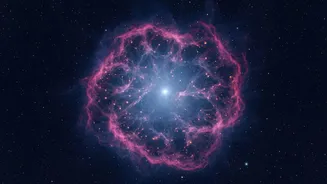
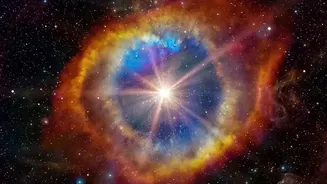
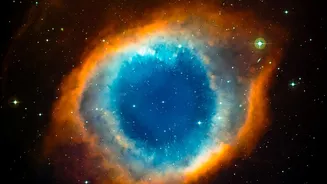
Located about 650 light-years away in the constellation Aquarius, the Helix Nebula is one of the closest and most iconic planetary nebulae known to us. Despite its name, it has nothing to do with planets. Instead, it’s the spectacular final act of a star
similar to our own Sun. For thousands of years, the dying star has been shedding its outer layers of gas, creating the intricate structure we see today. Because of its relative proximity and striking appearance, it has been a favorite target for telescopes for nearly two centuries, offering a preview of our own solar system's eventual fate. Previous images, like those from the Hubble Space Telescope, showed its ethereal, ring-like shape, but much of its finer structure remained obscured by dust and gas.
Webb's Unprecedented Infrared Vision
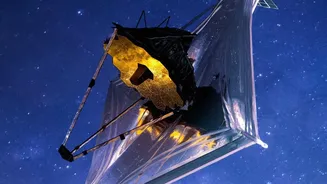
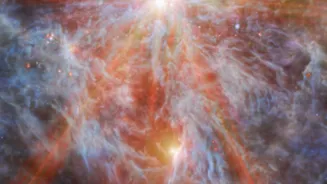
Enter the James Webb Space Telescope (JWST). Unlike Hubble, which primarily sees the universe in visible and ultraviolet light, Webb is designed to see in infrared. This allows it to peer through the clouds of dust that hide details from other telescopes and to detect the faint heat signatures of cooler gas and molecules. For the Helix Nebula, this is a game-changer. Webb’s Near-Infrared Camera (NIRCam) has provided the clearest and most detailed infrared view of the nebula to date, essentially giving scientists a new set of eyes to study this celestial wonder. The new images focus on a portion of the nebula's expanding shell, highlighting features that were only hinted at before.
The Mystery of the 'Cometary Knots'
One of the most fascinating features Webb has brought into focus are the thousands of “cometary knots” that dot the inner rim of the nebula. These are not actual comets, but dense clumps of gas and dust, each with a mass comparable to Earth's but spanning a size several times the orbit of Pluto. Webb's high-resolution images show these knots in incredible detail, revealing them as pillars with extended tails streaming away from the nebula's central star. These structures form where blistering, fast-moving hot gas from the dying star crashes into colder shells of material that were ejected earlier in its life. While the existence of these knots was known, Webb’s clarity allows scientists to study their formation and evolution, a process still not fully understood.
A Rainbow of Cosmic Chemistry
Webb’s images are not just beautiful; they are a map of the nebula's chemistry and temperature. The colors in the new images represent the transition from hot to cool gas. Intense radiation from the central white dwarf—the star's leftover core—heats the gas closest to it, which glows blue. Farther out, the gas cools and hydrogen atoms begin to form molecules, appearing as yellow and gold. In the coolest, outermost regions, traced in red, more complex molecules and dust can begin to form. This process is vital, as it shows how a dying star recycles its material back into the cosmos, creating the raw ingredients from which new stars and planets will eventually be born. Webb is allowing us to watch stellar death seeding the next generation of cosmic life in real-time.