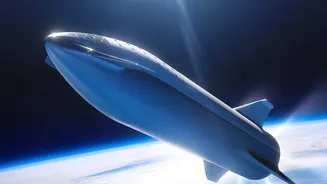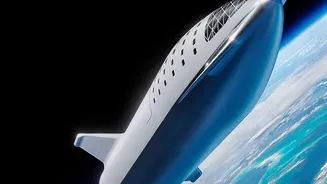





SpaceX's plan for its next-generation Starship rocket includes a maneuver straight out of science fiction: catching the skyscraper-sized vehicle with a pair of giant mechanical arms. It seems impossibly complex, but it’s a calculated engineering decision.
The Problem with Landing Legs
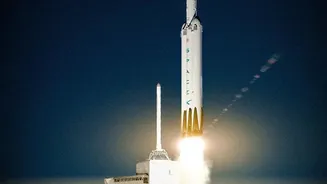
For years, SpaceX has amazed the world by landing its Falcon 9 boosters upright using deployable landing legs. It’s a proven, reliable system. So why abandon it for Starship? The answer is mass. Landing legs, and the structure needed to support them, are heavy. While manageable on the Falcon 9, scaling them up for the gargantuan Super Heavy booster and Starship upper stage would add a significant weight penalty. In rocketry, every kilogram of the rocket's own structure is a kilogram that can't be used for payload, whether that's satellites, cargo, or crew. By removing the legs, SpaceX can dedicate more of Starship’s lifting capability to its actual mission. The company’s core philosophy is that the 'best part is no part', and eliminating the entire landing leg system is a prime example of this thinking in action.
Meet 'Mechazilla': The Launch and Catch Tower
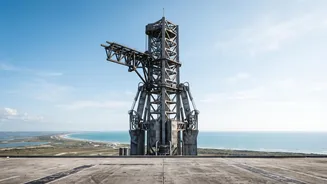
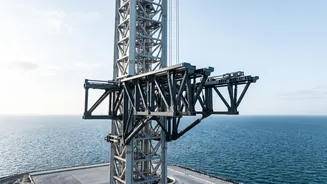
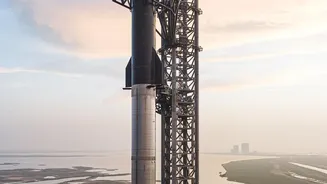
The replacement for landing legs isn't on the rocket itself, but on the ground. At its Starbase facility in Texas, SpaceX has constructed an enormous Orbital Launch Integration Tower, standing roughly 146 meters (about 480 feet) tall. Attached to this tower is a massive carriage with two large, hydraulically-powered arms. Unofficially nicknamed 'Mechazilla' or the 'chopsticks', this mechanism has a dual purpose. First, it lifts and stacks the Super Heavy booster and the Starship spacecraft on the launch mount before flight. Its second, more dramatic role is to catch both vehicles as they return from space. This strategy shifts the mass and complexity of the landing hardware from the rocket, which has to fly, to the ground tower, which doesn't.
How the Catch Is Supposed to Work
The sequence is a breathtaking feat of precision engineering. After separating from the Starship upper stage, the Super Heavy booster performs a series of engine burns to reverse its course and fly back to the launch site. Using its four large grid fins for steering, it guides itself through the atmosphere toward the tower. In the final moments, a landing burn using its Raptor engines slows the massive booster to nearly a hover right next to the tower. With the booster perfectly positioned, the chopstick arms close around structural hardpoints located near the top of the booster, just below the grid fins. The rocket's engines then cut off, and the tower arms absorb the final load, holding the booster securely in the air. On October 13, 2024, SpaceX successfully performed this maneuver for the first time, catching a Super Heavy booster after a test flight. The same principle is planned for the Starship upper stage, which would complete the full recovery of the entire launch system.
The Ultimate Payoff: Rapid Reusability
The tower-catch strategy is about more than just saving mass; it's the key to unlocking SpaceX's ultimate goal of rapid and complete reusability. A rocket caught by the tower is already positioned at the launch site, ready to be inspected, placed back on the launch mount, refueled, and paired with a new payload. This process could theoretically reduce the turnaround time between launches from weeks or days to mere hours. Elon Musk has compared the vision to that of an airline, where aircraft are designed to fly multiple times per day with minimal downtime. This high launch cadence is critical to the business model for Starship, which includes deploying next-generation Starlink satellites and enabling ambitious missions to the Moon and Mars that require multiple launches in a short period for orbital refueling.
An Audacious, High-Stakes Gamble
While the booster catch has been demonstrated, the system remains incredibly ambitious and fraught with risk. The precision required to guide a returning rocket into a specific catch window measured in meters is extraordinary. The control systems rely on advanced software, GPS, and real-time data to adjust the rocket's trajectory with its engines and grid fins. A failure during the final approach could be catastrophic, potentially damaging not only the vehicle but also the launch tower itself, which is the single most critical piece of ground infrastructure. SpaceX is essentially trading the known, distributed risk of landing on legs (where a failure might destroy one vehicle) for a centralized, higher-stakes risk where a failure could cripple its entire launch operation at that site. It is a bold trade-off that perfectly encapsulates the company's high-risk, high-reward approach to redefining the economics of spaceflight.