



The Universe’s Invisible Architect
Imagine trying to understand a city by only looking at its streetlights. You’d see points of light, but you'd miss the roads, the buildings, and the entire structure holding it all together. In cosmology, the stars and galaxies we see are just the streetlights. The
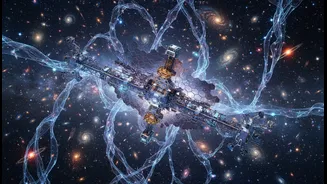
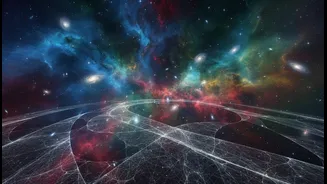
vast, unseen structure is dark matter, a mysterious substance that doesn’t absorb, reflect, or emit any light. Scientists know it exists because of its gravitational effects on the things we can see; it’s what keeps galaxies from flying apart and what governs the large-scale structure of the cosmos, often called the cosmic web. Mapping this invisible matter is therefore essential to understanding how the universe evolved and what its ultimate fate might be.
A Cosmic Cartographer with a Wider View
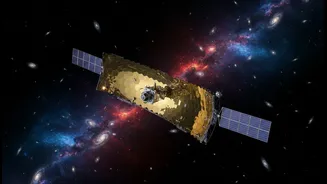
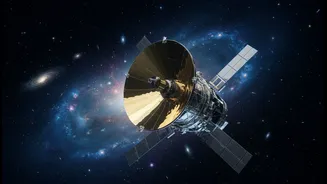
Enter the Nancy Grace Roman Space Telescope, NASA’s next great observatory, scheduled to launch in the near future. While telescopes like Hubble have given us breathtakingly deep views of small patches of sky, Roman is built for breadth. Its primary mirror is the same size as Hubble's, ensuring sharp, high-resolution images. However, its Wide Field Instrument will provide a field of view 100 to 200 times greater than Hubble's infrared camera. This panoramic capability is the key to its new approach. Instead of patching together hundreds of small images to survey an area, Roman can capture vast swathes of the universe in a single shot, making it an ideal tool for creating the largest, most detailed map of dark matter ever attempted.
Mapping Shadows with Gravitational Lensing
So, how do you map something that's invisible? Roman will primarily use a technique called weak gravitational lensing. According to Einstein's theory of relativity, massive objects warp the fabric of spacetime. As light from a distant galaxy travels to us, its path is slightly bent if it passes by a massive object, like a clump of dark matter. This bending subtly distorts the apparent shape of the background galaxy. The effect from any single clump is tiny and imperceptible. But by surveying hundreds of millions of galaxies, Roman can measure these minute, correlated distortions across the sky. By analyzing these patterns statistically, astronomers can work backward to create a detailed map showing the distribution of all the mass—both visible and dark—that caused the light to bend.
More Than Just One Trick
Roman's approach isn't limited to just one method. The mission will also hunt for dark matter and exoplanets using a phenomenon called microlensing. This occurs when a star or planet passes in front of a more distant star, and its gravity acts like a lens to briefly magnify the background starlight. This technique is sensitive enough to detect rogue planets and even smaller concentrations of dark matter that wouldn't be found through other methods. Furthermore, Roman will identify tens of thousands of instances of strong gravitational lensing, where the light from a background galaxy is warped into dramatic arcs and multiple images by a massive foreground galaxy. Studying these cosmic lenses will allow scientists to precisely measure the mass distribution in the foreground galaxy, providing crucial tests for different theories about the particle nature of dark matter.
A New Era of Cosmology
By combining its vast survey speed with these powerful techniques, the Roman Space Telescope is poised to revolutionize our understanding of the dark universe. The unprecedentedly detailed maps it will generate will allow scientists to test our fundamental theories of cosmic evolution and structure formation. These new maps will not only show us where the dark matter is but also help us understand its properties. Is it made of a single type of particle? Does it interact with itself? The answers to these questions could be hidden within the fine details of the cosmic web that Roman will reveal. Working in tandem with other observatories like the James Webb Space Telescope, Roman will provide the big-picture context, identifying key targets for more detailed follow-up studies.