



More Than a Sweet Discovery
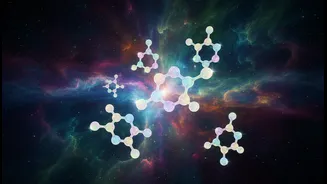
In a landmark finding, astronomers have detected a sugar molecule called erythrulose floating in a molecular cloud near the center of our Milky Way galaxy. Using powerful radio telescopes, a team of researchers identified the distinct chemical signature
of this four-carbon sugar in a vast cloud of gas and dust known as G+0.693-0.027, located roughly 27,000 light-years from Earth. While sugars have been found in meteorites and asteroid samples before, this is the first time a true sugar has been positively identified in the interstellar medium—the seemingly empty space between stars. What makes this so significant is that erythrulose is a relatively complex organic molecule, and its discovery challenges previous assumptions about what kind of chemistry is possible in such a cold, harsh environment.
The Ingredients for Life
The term "sugar" might bring to mind kitchen staples, but in biology, sugars are fundamental. They form the structural backbone of DNA and RNA, the molecules that carry the blueprint for life. For decades, a major puzzle in origin-of-life research has been the "sugar problem." Lab experiments simulating conditions on early Earth have struggled to produce sugars in the necessary quantities for life to begin. This led scientists to an exciting alternative theory: what if the key ingredients weren't made on Earth, but delivered from space? Discoveries of sugars like ribose on asteroids such as Bennu and Ryugu have provided strong evidence for this cosmic delivery system. The detection of erythrulose in interstellar space is a critical missing link. It proves that such molecules can form out in the galaxy, long before they are incorporated into the asteroids and comets that eventually seed young planets.
A Cosmic Chemical Kitchen
So, how does a sugar form in a place where temperatures can plummet to hundreds of degrees below zero? These molecular clouds are not empty voids; they are gigantic chemical factories. They are filled with tiny dust grains coated in ice. Over millions of years, simple atoms and molecules like water, methanol, and carbon compounds stick to the surfaces of these icy grains. Bombarded by cosmic radiation, these simple ingredients undergo chemical reactions, gradually building up into more complex structures. Scientists believe this is how erythrulose formed. The dust grains act as microscopic meeting points, allowing molecules to find each other and react in ways that would be impossible in the diffuse gas. This discovery confirms that the universe is an efficient organic chemist, capable of creating some of life’s most important components in the darkest, coldest corners of space.
From Interstellar Cloud to New Worlds
The journey of a molecule like erythrulose doesn't end in the interstellar cloud. These clouds are stellar nurseries, places where new stars and planetary systems are born. As a new star ignites, the surrounding disk of gas and dust begins to clump together, forming asteroids, comets, and eventually planets. The prebiotic molecules forged in the cold cloud, including sugars, get swept up in this process, becoming part of the raw material for these new worlds. During a period in our own solar system’s history known as the Late Heavy Bombardment, it’s thought that comets and asteroids constantly rained down on a young Earth, delivering water and these essential organic compounds. Scientists calculated that millions of tons of erythrulose could have been delivered to Earth during this time, providing a rich inventory of prebiotic ingredients that could have kickstarted life.