






The High Cost of Abandonment
For decades, space has operated on a disposable model. Satellites, some costing hundreds of millions of dollars, are launched with a finite lifespan. When they run out of propellant for maneuvering or a single component fails, they are often abandoned.
These defunct assets either become a collision risk or are moved to a remote 'graveyard' orbit. With over 8,000 operational satellites and tens of thousands more planned, the problem of orbital congestion and waste is growing exponentially. Each year, 10 to 20 high-value satellites in geostationary orbit alone reach their end of life, not because their valuable instruments have failed, but simply because they've run out of fuel. This represents a significant loss of investment and capability.
Enter the Robotic Mechanics
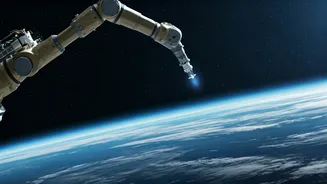
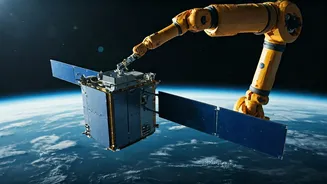
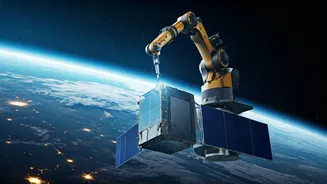
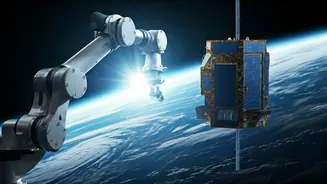
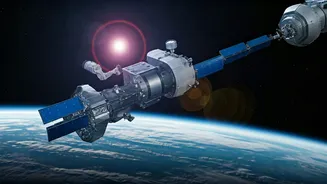
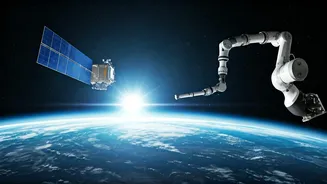
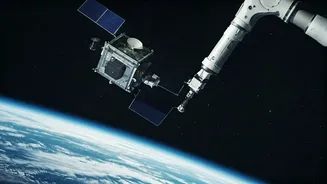
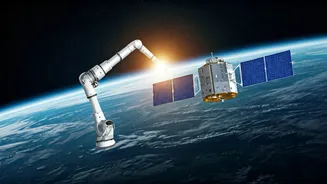
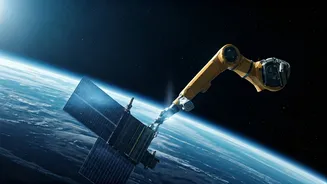
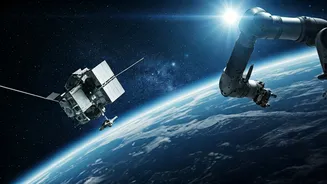
The solution emerging is on-orbit servicing (OOS), a field dedicated to inspecting, repairing, refueling, and upgrading satellites directly in space. Imagine a robotic 'roadside assistance' vehicle that can rendezvous with a satellite, dock with it, and perform complex tasks. These servicer spacecraft are equipped with advanced robotic arms, cameras, and specialized tools. One of the most successful examples is Northrop Grumman's Mission Extension Vehicle (MEV). MEV-1 and MEV-2 successfully docked with Intelsat communications satellites in 2020 and 2021, respectively, taking over their propulsion and attitude control functions to grant them years of additional service life. This proved that commercial life-extension was not just possible, but a viable business.
From a Boost to a Full Repair
The technology is rapidly evolving beyond simple life extension. In a mission launching in mid-2026, NASA is partnering with the startup Katalyst Space to save the Neil Gehrels Swift Observatory. The aging telescope's orbit is decaying, and Katalyst's three-armed robotic spacecraft, named LINK, will be launched to rendezvous with Swift, capture it, and boost it into a higher, more stable orbit. This mission is seen as a critical test case for servicing satellites that were never designed for maintenance. Looking further, DARPA's Robotic Servicing of Geosynchronous Satellites (RSGS) program, also slated for a 2026 launch, aims to demonstrate more complex tasks like inspections, anomaly resolution, and on-orbit upgrades using highly dexterous robotic arms.
Building the Future in Space
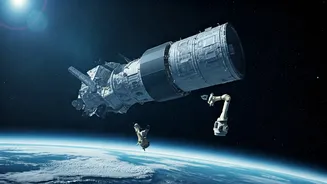
The implications of mature on-orbit servicing are profound. Beyond just fixing what's broken, the technology enables On-orbit Servicing, Assembly, and Manufacturing (OSAM). This could allow for the construction of massive structures in space—like next-generation telescopes or space stations—that are too large to fit into a single rocket fairing. Robots could assemble components piece by piece in orbit. This capability transforms the very architecture of space missions, moving from monolithic, single-launch spacecraft to modular, upgradable, and sustainable platforms. It also underpins a more circular space economy, where resources are reused and waste is minimized.
The Challenges on the Horizon
Despite the promise, significant hurdles remain. One of the biggest challenges has been developing robots capable of servicing 'unprepared' satellites—those not designed with standard docking ports or accessible fuel valves. NASA's ambitious OSAM-1 mission, which aimed to refuel an unprepared Landsat satellite, was canceled in 2024 due to cost and schedule challenges, highlighting the immense technical difficulty. Furthermore, there are complex legal and regulatory frameworks to develop for operations in a domain where multiple nations have assets. Establishing standardized interfaces for docking and refueling across the industry is another key step needed to make servicing a routine part of space operations.