
Capturing the Flash
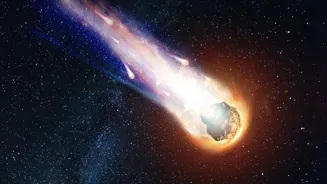
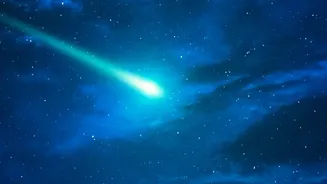
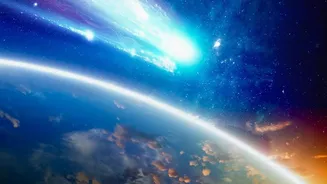
The investigation begins the moment a meteoroid, a piece of an asteroid or comet, hits Earth’s atmosphere. Travelling at immense speeds, the rock compresses the air in front of it, generating intense heat and creating a spectacular fireball. To capture
this event, scientists rely on networks of sophisticated cameras. Organizations like NASA’s All-sky Fireball Network and the global Desert Fireball Network operate automated observatories that constantly watch the sky. These systems, often equipped with fish-eye lenses, are positioned to have overlapping fields of view. When a fireball streaks past, multiple cameras record it from different angles. This multi-perspective approach is crucial for the next step: triangulation.
Mapping the Fall
With data from at least two different stations, researchers can reconstruct the meteor's precise path through the atmosphere. Using the background stars as a fixed reference, they can calculate the fireball's trajectory, altitude, and velocity. This process is like a form of cosmic surveying. Scientists can determine how fast the object was moving and how it decelerated as it encountered atmospheric drag. This initial analysis is not only vital for understanding the object's journey but also for a more immediate goal: figuring out if any part of it survived the plunge. By modelling the trajectory and accounting for factors like wind speed during its unlit 'dark flight' phase, scientists can predict a potential landing zone, or “strewn field,” where meteorite fragments may be found.
Rewinding the Cosmic Clock
The most fascinating part of this process is using the atmospheric path to calculate the meteoroid's pre-Earth orbit. By knowing the rock’s speed and direction just before it was significantly slowed by the atmosphere, astronomers can essentially run the physics in reverse. They mathematically remove the effects of Earth's powerful gravity to determine the object's original path around the Sun. This reveals its heliocentric orbit, a cosmic fingerprint that holds clues to its origin. Was it a near-Earth asteroid, or did it come from the main asteroid belt between Mars and Jupiter? The shape and tilt of this orbit provide the first major piece of evidence in identifying the rock’s home neighbourhood in the solar system.
The Search for Physical Clues
While orbital data points to a region of space, the ground search provides physical proof. Finding the fallen meteorites is a race against time, as terrestrial weather can quickly alter or contaminate these precious samples. The predicted strewn field gives hunters a starting point. Once a potential meteorite is located, its appearance offers initial clues. A dark fusion crust forms as the surface melts during atmospheric entry, and its high density, often due to iron-nickel content, makes it feel surprisingly heavy for its size. Many stony meteorites also contain chondrules—tiny, spherical grains that formed in the early solar system and are not found in Earth rocks. These features help confirm its extraterrestrial origin before it is sent to a lab for deeper analysis.
Reading the Rock's Life Story
In the laboratory, the meteorite begins to tell its full story. Scientists analyse its mineral and chemical composition, which can be matched to the known makeup of celestial bodies. For instance, the spectral signature of certain meteorites has been definitively linked to the asteroid Vesta. Furthermore, isotopic analysis—examining the ratios of different forms of elements like oxygen—can provide a unique signature linking a rock to a specific parent body, such as Mars. Scientists can even determine how long the rock travelled through space. By measuring the effects of long-term exposure to cosmic rays, they can calculate when it was chipped off its parent asteroid, sometimes revealing a journey that lasted millions of years.