






A Groundbreaking 'Hint' of Water
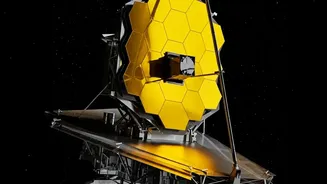
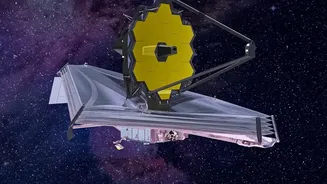
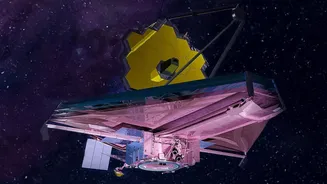
The James Webb Space Telescope has picked up a faint but compelling signal: the chemical fingerprint of water vapour around a rocky exoplanet. Specifically, observations of a world named GJ 486 b, a 'super-Earth' about 26 light-years away, show tantalising
hints of water. While water has been found on giant gas planets before, detecting its presence near a rocky world is a monumental step forward. However, scientists are urging caution. The signal is ambiguous, and it's not yet clear if the water belongs to the planet itself or if it's coming from the cool star it orbits. This discovery represents the very edge of our current technological capabilities, pushing the limits of what we can learn about these distant worlds.
What Are Super-Earths?
Super-Earths are a class of exoplanet more massive than Earth but lighter than our solar system's ice giants like Neptune. They are incredibly common throughout the galaxy, yet strangely, our own solar system doesn't have one. The term refers only to a planet's mass and size—typically up to 10 times the mass of Earth—and doesn't imply anything about its surface conditions or habitability. These planets can be rocky like Earth, gaseous like Neptune, or even water worlds. The discovery of any kind of atmosphere around a rocky super-Earth is significant because it helps answer a crucial question: can a planet orbiting close to its star hold onto a layer of gas, or does the star's intense radiation just strip it away?
The Challenge: Planet or Star?
Detecting the atmosphere of a rocky exoplanet is incredibly difficult. Scientists use a method called transit spectroscopy, where the JWST observes the light from a star as its planet passes in front. If the planet has an atmosphere, certain wavelengths of light are absorbed by the gases within it, leaving a tell-tale signature for astronomers to analyse. For GJ 486 b, the data showed a signature consistent with water. The problem is that the planet's host is a cool red dwarf star. These stars can have cool 'starspots' (like sunspots) that are cool enough for water vapour to form. The signal Webb detected could be from these spots on the star, perfectly mimicking an atmosphere on the planet. Researchers are now planning further observations with other JWST instruments to solve this cosmic mystery.
Not a Habitable Paradise
Even if the water vapour is confirmed to be from the planet, GJ 486 b is no Earth 2.0. With a surface temperature of around 430 degrees Celsius (800 degrees Fahrenheit), it's far too hot for liquid water or life as we know it. It orbits its star in less than two Earth days and is likely tidally locked, meaning one side permanently faces the star in perpetual daylight, while the other is in endless night. If the planet does have a steamy atmosphere, it would likely need to be constantly replenished by volcanic activity, with steam jetting out from the planet's interior to counteract the stripping effect of its nearby star.
A Promising Future for Exploration
While GJ 486 b is inhospitable, the techniques used to find these water signatures are paving the way for future discoveries. Other recent Webb observations, such as those of the lava world 55 Cancri e, have provided the best evidence yet for a substantial atmosphere around a rocky planet, possibly rich in carbon dioxide or carbon monoxide and sustained by a magma ocean. Each observation is a crucial proof of concept, demonstrating that JWST has the power to detect atmospheres on smaller, rockier worlds. These findings are not just about individual planets; they are about refining our understanding of how planetary systems form and whether atmospheres, a key ingredient for life, can survive in harsh environments.