





A Frozen Time Capsule
Far beyond the orbit of Neptune lies the Kuiper Belt, a vast, frigid donut-shaped ring of icy bodies. This region is often described as a 'time capsule' of our solar system. Its inhabitants are remnants from the dawn of our planetary neighbourhood, preserved
in a deep freeze for billions of years. While many asteroids closer to the Sun are primarily rock and metal, Kuiper Belt Objects (KBOs) are largely composed of frozen volatiles like methane, ammonia, and water. Studying this region helps scientists understand the building blocks of planets and the conditions that existed during the solar system's formation. But sending a mission to scoop up a sample and bring it home from such a great distance is a monumental challenge. Instead, scientists often rely on the next best thing: the dust these objects shed.
Catching Stardust in the Stratosphere
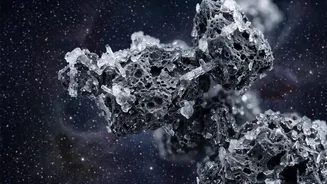
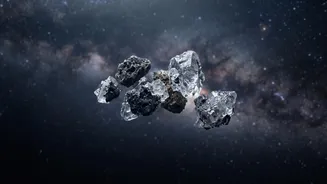
The dust grains at the heart of this recent study were not captured in deep space by a probe but high in Earth's own atmosphere. NASA aircraft regularly fly through the stratosphere to collect interplanetary dust particles (IDPs) that have journeyed from afar. Over time, dust from cometary tails and collisions between asteroids and KBOs spirals inward toward the Sun, with a fraction of it entering our atmosphere. In this case, researchers led by Lindsay Keller of NASA's Johnson Space Center identified twelve specific grains with unique characteristics. They were able to trace their origin to the Kuiper Belt by analysing the high density of scars left by solar energetic particles—a type of radiation damage that indicates a very long journey through space.
Clues Hidden Within the Grains
Despite their microscopic size, these twelve particles carried a fascinating story. Analysis revealed they were mainly composed of hydrated minerals, including clays, which can only form in the presence of liquid water. This provides direct evidence that liquid water once reacted with rock inside the parent bodies from which this dust originated. Even more intriguing was the water's chemical signature. The minerals preserved a record of water that was highly enriched in 'heavy' oxygen isotopes. This supports a long-held theory that a distinct reservoir of water, largely isolated from the material mixing in the inner solar system, exists in its outermost regions. The findings suggest the chemistry that shaped the distant solar system was different from that which formed planets closer to the Sun.
The All-Important Caveat: Sample Size
This is where the headline's crucial context comes into play. The findings from these twelve grains are compelling, but it is essential to remember that they represent an incredibly small sample. Drawing sweeping conclusions about the entire Kuiper Belt—a region that is 20 times as wide and up to 200 times as massive as the asteroid belt—based on a dozen tiny particles would be like trying to understand the geology of all of India by studying a handful of pebbles from a single beach. The results are a vital clue, not a definitive answer. Scientists acknowledge this limitation, noting that a broader sample is needed to determine if this unique chemical signature is common across many KBOs or reflects the specific history of just a small group of objects. The study provides a starting point and a chemical pattern to look for in future samples.
The Path Forward for Dust Hunters
This research complements the ongoing work of NASA's New Horizons spacecraft, which is currently travelling through the Kuiper Belt. Its Student Dust Counter (SDC) instrument has been making the first-ever direct measurements of dust in this distant region. Interestingly, the SDC has detected higher-than-expected levels of dust, suggesting the Kuiper Belt might be more extended or active than models predicted. The analysis of the twelve stratospheric grains gives researchers a specific 'fingerprint' to search for, helping to connect in-situ spacecraft data with laboratory analysis of collected particles. The ultimate goal is to build a more complete and accurate model of the dust distribution and composition in the outer solar system, which in turn will refine our understanding of how planetary systems, including our own, come to be.