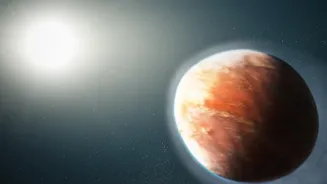


In the vast expanse of space, planets are not supposed to simply disappear. Yet, that is precisely what seemed to happen to a world 25 light-years away, leaving astronomers with a cosmic mystery that has now been brilliantly solved.
The Phantom Planet Appears
The story begins in 2004,
when the Hubble Space Telescope captured remarkable images of a bright, moving dot near the star Fomalhaut. Announced to the world in 2008, this object, named Fomalhaut b, was celebrated as one of the very first exoplanets to be directly photographed in visible light. It appeared to be a massive world, possibly larger than Jupiter, orbiting its star in a wide, distant arc. For years, it was a poster child for exoplanet discovery, a tangible world beyond our solar system that we could actually see. But Fomalhaut b had its secrets. From the start, it was an oddball, showing strange characteristics that didn't quite fit the profile of a normal planet.
A Cosmic Disappearing Act
As astronomers continued to monitor Fomalhaut b with Hubble over the next decade, the mystery deepened. The 'planet' was not behaving as expected. For one, it was unusually bright in visible light but had no detectable heat signature in the infrared, which is puzzling for a large gas giant. More bafflingly, follow-up observations showed the object was slowly fading. And then, in images taken in 2014, Fomalhaut b was gone. It had completely vanished. As one of the lead researchers, András Gáspár, noted, the object 'was doing things a bona fide planet should not be doing'. Planets don't just expand, fade, and then disappear. A new, more dramatic explanation was needed.
The Case of the Ghost World
To solve the puzzle, astronomers led by Gáspár and George Rieke of the University of Arizona revisited all the archival data from Hubble. Their investigation revealed the truth: Fomalhaut b was never a planet at all. Instead, what Hubble had first detected was a massive, expanding cloud of dust. The most likely cause was a spectacular, violent collision between two large icy bodies, each about 200 kilometres in diameter. This cataclysmic event, which likely occurred shortly before the first observation in 2004, created a dense cloud of fine dust particles that reflected the light from the central star, Fomalhaut, making it appear as a bright, planet-like object.
An Expanding Cloud of Debris
The 'disappearance' was simply the result of this dust cloud expanding and dispersing over time. As the particles spread out, the cloud grew fainter and larger. By 2014, the debris cloud had expanded to a size larger than the orbit of Earth around our sun, and its fine dust particles—each smaller than the width of a human hair—had spread so thin that they were no longer detectable by Hubble. The planet hadn't vanished; it had, in effect, dissolved into space. The trajectory of the cloud also provided a clue; it appeared to be on an escape path, being pushed away from the star by radiation pressure, rather than in a stable elliptical orbit like a planet.
Why This 'Collision' Matters
While the loss of a famous exoplanet might seem like a disappointment, the real story is arguably more exciting. Witnessing the aftermath of a collision between large, planet-forming bodies is incredibly rare. 'These collisions are exceedingly rare and so this is a big deal that we actually get to see one', Gáspár explained. This event provides a unique window into the chaotic and destructive processes that shape young planetary systems. Our own solar system's history is filled with such impacts, which helped form planets like Earth and our Moon. Observing this process around Fomalhaut acts as a 'blueprint of how planets destroy each other', giving scientists a real-time look at the violent birth pangs of a solar system. It's a powerful reminder that the formation of planets is not a gentle process, but a dramatic cosmic ballet of creation and destruction.