




The World's Largest Mangrove Fortress
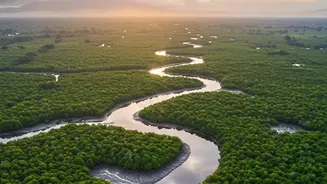
Spanning the delta of the Ganges, Brahmaputra, and Meghna rivers, the Sundarbans is the largest contiguous mangrove forest on Earth. This UNESCO World Heritage site is more than just a beautiful, dense labyrinth of tidal waterways and islands; it's a biodiversity
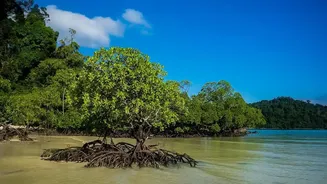
hotspot and a natural shield for millions of people in coastal West Bengal and Bangladesh. The intricate root systems of the mangroves act as a formidable barrier against cyclones and storm surges, a service that has become increasingly vital with rising sea levels. However, this unique ecosystem has faced decades of degradation from human activity, erosion, and climate change, losing significant forest cover over the years. In response, numerous government and non-governmental organizations have initiated large-scale restoration projects, planting millions of mangrove saplings to rebuild this green wall.
Decoding Blue Carbon
While all forests store carbon, mangroves are in a class of their own. The carbon captured and stored by coastal and marine ecosystems is known as 'blue carbon'. Mangrove forests are exceptionally efficient at this, sequestering carbon at a rate up to four times greater than mature tropical rainforests. Unlike terrestrial forests that store carbon primarily in their biomass (trunks and leaves), mangroves are masters of below-ground storage. Their complex root systems trap and bury organic matter in the soil, where the low-oxygen conditions prevent it from decomposing and releasing carbon back into the atmosphere. This makes the muddy soil of the Sundarbans one of the most significant carbon sinks on the planet, locking away vast amounts of carbon for long periods.
An Eye in the Sky
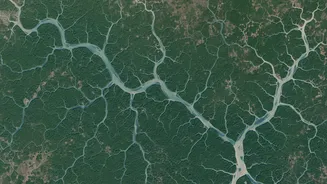
Measuring carbon stored across thousands of square kilometres of dense, often inaccessible forest is a monumental challenge. This is where satellite technology comes in. Modern remote sensing offers a powerful, non-destructive way to estimate forest biomass and, by extension, carbon stocks. Satellites equipped with various sensors, such as optical, radar (like the European Space Agency's Biomass mission), and LiDAR, can 'see' through the forest canopy. By analysing the data these satellites collect—from canopy height and density to leaf area—scientists use sophisticated machine learning models to calculate the amount of aboveground biomass. These digital measurements are calibrated and verified with on-the-ground field data to ensure accuracy, allowing for a comprehensive and repeatable assessment of the entire forest's health and carbon storage capacity without time-consuming fieldwork.
Quantifying the Gains
Recent studies utilising this cutting-edge approach have delivered promising news. By combining satellite data from sources like Sentinel-1 and Sentinel-2 with machine learning algorithms, researchers are now able to quantify the success of restoration efforts. The data reveals that restored areas of the Sundarbans are showing significant gains in biomass, which directly translates to increased carbon sequestration. One study projected that the Indian Sundarbans' carbon stock could reach over 460 megagrams per hectare by 2025, with a steady increase predicted throughout the century. Another analysis using a Random Forest machine learning model calculated an annual carbon sequestration rate of 257 megagrams per hectare, with the aboveground biomass figures consistent with those from traditional field studies. These figures prove that restoring mangrove habitats is one of our most effective nature-based solutions to climate change.
From Data to Policy and Protection
This technological leap is more than just an academic exercise. The ability to accurately and efficiently monitor blue carbon stocks has profound implications. For India, it provides a clear, data-backed justification for initiatives like the national 'MISHTI' scheme, which aims to promote mangrove plantation along the coastline. Reliable data on carbon sequestration helps in tracking progress towards national climate goals, such as those outlined in the Paris Agreement. Furthermore, it can unlock new financial avenues. By verifying the amount of carbon being sequestered, these restoration projects can potentially qualify for carbon credits, creating economic incentives for further conservation. This fusion of technology and conservation allows us to not only witness the revival of the Sundarbans but also to assign a tangible value to its role in protecting our planet.