


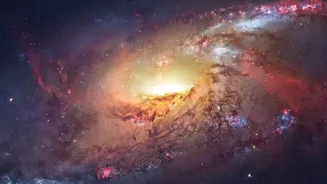
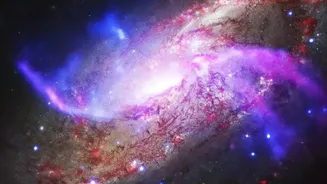
More Than Meets the Eye
Our eyes are incredible, but they can only see a tiny slice of all the light in the universe, known as visible light. The full range, called the electromagnetic spectrum, includes everything from low-energy radio waves to high-energy X-rays and gamma
rays. Different celestial events and objects shine most brightly in different parts of this spectrum. A cool gas cloud might be invisible to our eyes but glow brightly for a radio telescope. A superhot explosion might only appear in X-rays. To get the full picture of a galaxy, astronomers need to look at it with different kinds of 'eyes'—telescopes designed to see these invisible wavelengths. This method, called multi-wavelength astronomy, is like combining several different maps to reveal a complete world.
The Radio View: Cosmic Gas and Monster Jets
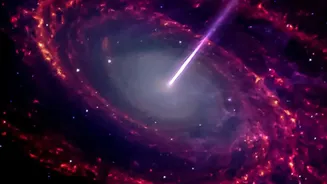
When astronomers point a radio telescope at a galaxy, they aren't looking for stars. They're seeing things that are much colder and more expansive. Radio waves cut straight through the cosmic dust that can obscure visible light, revealing vast clouds of cool hydrogen gas—the raw fuel for future star formation. But radio waves also show us some of the most powerful phenomena in the cosmos. At the heart of many galaxies, including the nearby Centaurus A, lies a supermassive black hole. As this behemoth feeds on gas and dust, it can launch colossal jets of particles at nearly the speed of light. These jets are invisible in ordinary light but blaze brightly in radio waves, often stretching for thousands of light-years, far beyond the visible boundaries of the galaxy itself.
The Infrared View: A Cradle of Newborn Stars
If radio waves show the fuel, infrared light reveals the fire. Infrared is essentially heat radiation. While our eyes can't see it, telescopes sensitive to infrared can pierce through thick veils of dust to find where new stars are being born. These stellar nurseries are dense clouds where gas and dust collapse to form protostars. The process generates immense heat, causing the surrounding dust to glow brightly in infrared light, even when the stars themselves are completely hidden from view. By looking at a galaxy like Centaurus A in the infrared, astronomers can map out its star-forming regions. What appears as a dark, obscuring dust lane in a visible-light image transforms into a vibrant, glowing band where a new generation of stars is bursting into life.
The X-Ray View: A High-Energy Drama
X-rays are the calling card of the most violent and energetic processes in the universe. An object has to be millions of degrees Celsius to shine in X-rays, so this view reveals a galaxy's most extreme environments. When matter spirals into a supermassive black hole, it gets super-heated and emits an intense torrent of X-rays just before it disappears forever. This allows astronomers to study the immediate surroundings of these cosmic monsters. The X-ray view also captures the shockwaves from exploded stars (supernova remnants) and pinpoints smaller black holes scattered throughout the galaxy. In Centaurus A, X-ray telescopes have traced the high-energy jets shooting out from the central black hole and identified hundreds of smaller, bright sources that indicate a history of stellar chaos and destruction.