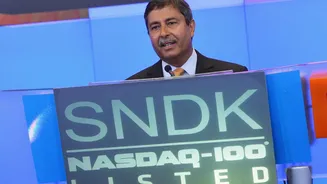








A market valuation of $1.5 trillion is a number so large it seems to defy gravity. For AI startup Anthropic, which hit that figure during its record-breaking IPO, it’s the headline on a deeper story about the siblings at its helm, Dario and Daniela Amodei.
That Trillion-Dollar Question
First, let's address the eye-watering figure. Anthropic’s initial public offering in November 2026 was a blockbuster, pricing at $83 per share to give the company a valuation of around $1.5 trillion. On its first day of trading on the Nasdaq, the valuation even briefly surpassed $2 trillion. This places Anthropic in the same rarefied air as giants like Apple and Microsoft, an astonishing feat for a company founded only in 2021. The massive valuation reflects white-hot investor appetite for leadership in the artificial intelligence sector, a field that Anthropic is helping to define. While the number is real, it’s also a forward-looking bet on the company’s potential to dominate a technology expected to reshape the global economy.
The Family at the Forefront
At the heart of Anthropic are co-founders and siblings Dario and Daniela Amodei. CEO Dario, a respected AI researcher, and President Daniela, who oversees business and operations, form a complementary duo guiding the company. Both were senior figures at rival lab OpenAI, where Dario was VP of Research and Daniela was VP of Safety and Policy. In 2021, they left, along with a group of other senior researchers, reportedly over differences in vision for how to safely develop and commercialize powerful AI technology. They founded Anthropic with a distinct mission: to prioritize AI safety alongside capability. This 'safety-first' ethos is not just a talking point; it's the core of their business and a key differentiator in a fiercely competitive market.
A 'Constitution' for AI
Anthropic's signature innovation is not just a more powerful model, but a different approach to building one. It's called 'Constitutional AI'. Instead of relying solely on massive amounts of human feedback to prevent harmful or biased outputs, Anthropic trains its models with a set of explicit principles—a constitution. The AI is taught to critique and revise its own responses to align with these rules, which include principles of helpfulness, honesty, and harmlessness. This method is designed to create more reliable and steerable systems, which the Amodeis argue is essential for building public trust and ensuring AI develops in a way that benefits humanity. It’s a technical solution to a deeply philosophical problem: how to embed human values into an artificial mind.
Meet Claude, the Flagship Product
The public face of Anthropic's research is Claude, its family of large language models that compete directly with OpenAI's ChatGPT and Google's Gemini. The Claude models are the tangible result of the company's safety-focused philosophy and its commercial strategy. The business model relies on selling access to Claude through an API and to enterprise clients, many of whom are drawn to the promise of a more reliable and controllable AI partner. While the company is not yet profitable, its revenue has grown at a blistering pace, reaching billions annually as it scales. This rapid commercial growth is crucial, as it funds the incredibly expensive computing power needed for frontier AI research.
The Power of Big Backers
A $1.5 trillion valuation doesn’t materialize out of thin air. It’s built on staggering investment and strategic partnerships. Anthropic’s biggest backers are two of its biggest competitors: Amazon and Google. Following the IPO, the two tech giants collectively own around 28% of Anthropic's non-voting stock. This 'frenemy' relationship is complex. Both companies have invested billions and have also committed Anthropic to spending tens of billions on their cloud computing services over the next decade. They are simultaneously Anthropic's investors, its key infrastructure suppliers, and its primary distribution partners, selling access to Claude on their cloud platforms. This deep-pocketed support gives Anthropic the resources to compete at the highest level, while also raising questions about the concentration of power in the AI ecosystem.