



A Telescope on a Planetary Scale
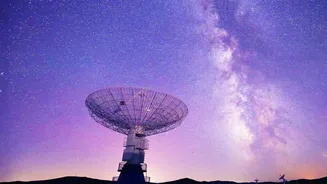
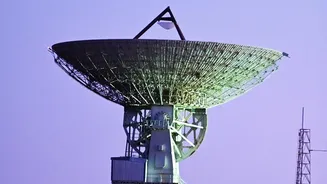
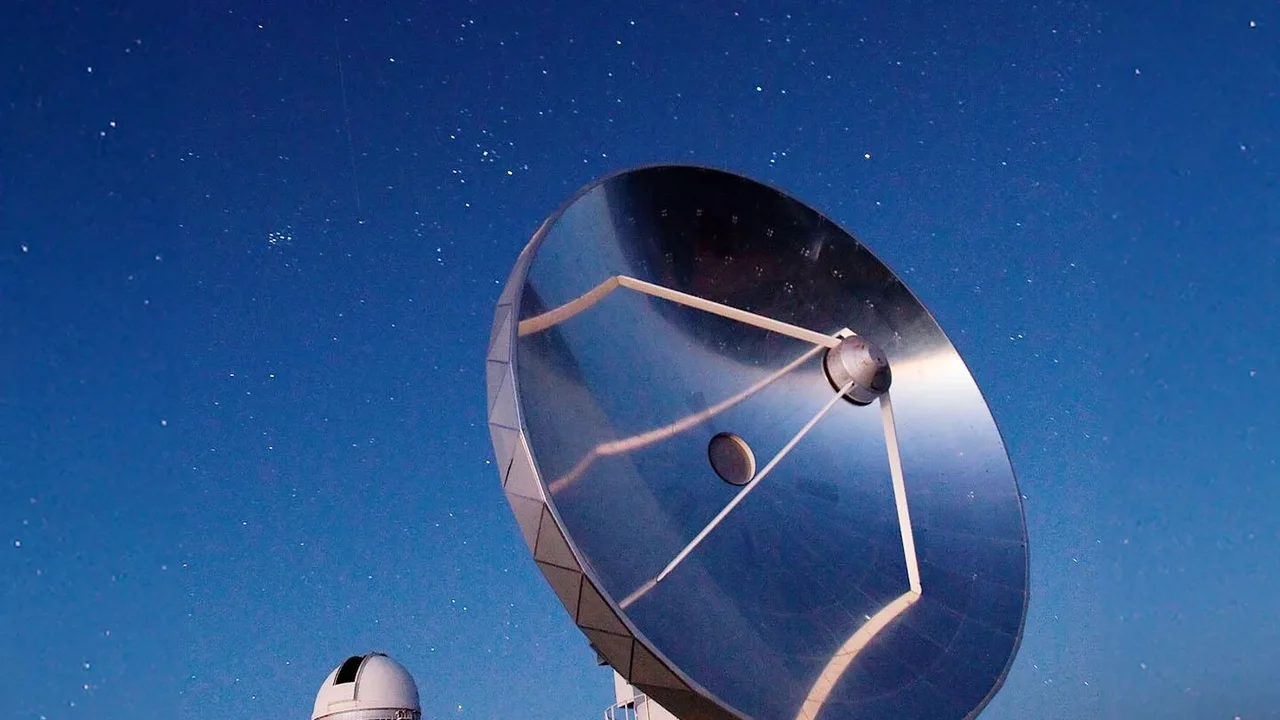
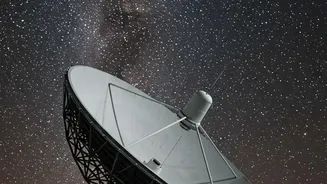
The SKA isn't a single instrument but a colossal network of thousands of antennas spread across two continents. Construction officially began in late 2022. The project has two main sites: SKA-Low in Western Australia and SKA-Mid in South Africa. The Australian
site will feature a vast array of over 131,000 Christmas tree-like antennas, while South Africa will host nearly 200 large dish antennas. Together, they will function as one enormous, virtual telescope with a combined collecting area that will eventually approach one square kilometre. This incredible scale will make the SKA 50 times more sensitive than any previous radio instrument, capable of surveying the sky thousands of times faster.
Peering into the Cosmic Dawn
The primary mission of the SKA is to answer some of the most fundamental questions about our universe. Its main goal is to observe the 'Cosmic Dawn', a period just a few hundred million years after the Big Bang when the very first stars and galaxies began to form. Before this, the universe was in a period known as the 'Dark Ages'. By detecting the faint radio signals from the hydrogen gas that filled the early universe, the SKA will create 3D maps of this formative era, revealing how the first pockets of light emerged and evolved. This will provide unprecedented insights into the processes that shaped the cosmos we see today.
India's Crucial Role in the Cosmic Quest
India is a full member of the SKA Observatory (SKAO) and a vital contributor to this global endeavour. The Indian government has committed ₹1,250 crore to the project's construction phase. This involvement is spearheaded by the National Centre for Radio Astrophysics (NCRA) in Pune, which leads a consortium of over 20 Indian institutions. One of India’s most significant contributions has been leading the design and development of the Telescope Manager, the complex software system that will act as the 'brain' and 'nervous system' of the entire observatory, controlling and monitoring all the telescope components. This places Indian expertise at the heart of the SKA's operations, building on the country's rich legacy in radio astronomy, including the world-renowned Giant Metrewave Radio Telescope (GMRT) near Pune.
The Data Tsunami and Its Challenges
The sheer volume of data the SKA will generate is staggering and presents one of the project's biggest challenges. The antennas will produce more data in a single day than the entire global internet traffic. Processing this information requires the development of new software and some of the world's fastest supercomputers. Indian institutions are playing a key role in developing the software for these supercomputers, particularly in the areas of data processing and imaging. The plan includes establishing an SKA Regional Centre in India to help process and store this immense data archive for use by the scientific community.
Beyond the First Stars
While observing the early universe is its headline mission, the SKA's capabilities will transform many other areas of astrophysics. Scientists will use it to test Albert Einstein's theories of gravity with extreme precision by studying pulsars, which are rapidly spinning dead stars. The telescope will also investigate the nature of dark matter and dark energy, mysterious components that make up about 95% of the universe. Other goals include mapping the role of cosmic magnetism, searching for the building blocks of life in space, and even contributing to the search for extraterrestrial intelligence. With construction underway and expected to be completed towards the end of the decade, the SKA promises a new golden age of astronomical discovery.