





A Continent's Hidden History
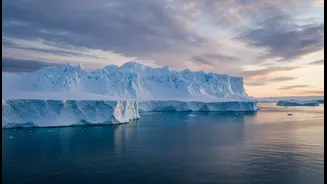
For decades, scientists believed the formation of Antarctica's massive ice sheet 34 million years ago was caused simply by a drop in global carbon dioxide levels. However, new findings published in July 2026 suggest a more complex story. Researchers now
argue that the slow, tectonic uplift of the Antarctic continent itself played a critical role. Over millions of years, as the supercontinent Gondwana broke apart, parts of Antarctica were pushed upwards, creating high-altitude plateaus where ice could form and persist even when the surrounding oceans were relatively warm. This geological head start explains why Antarctica froze over millions of years before the Arctic. This isn't just ancient history; it shows that the continent's stability is tied to a delicate balance of geology and climate, a balance we are now disrupting.
The Human Fingerprint on Melting Glaciers
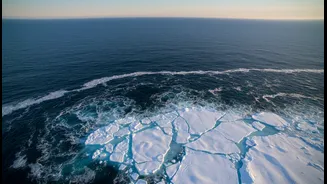
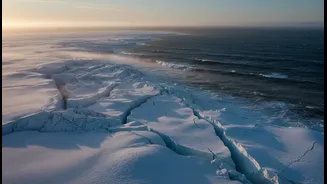
The connection between human activity and Antarctic melt has become clearer than ever. A landmark study recently provided the first direct link between human-caused climate change and the retreat of the vital Pine Island Glacier. This single glacier is one of the biggest contributors to global sea-level rise. The research found that while the glacier's retreat began in the 1940s due to natural warming ocean currents, greenhouse gas emissions have significantly accelerated this process, intensifying the retreat by as much as 20%. This confirms that our emissions are having a direct and measurable impact on even the most remote parts of our planet, with today's actions locking in ice loss for centuries to come.
Uncovering Tipping Points
Perhaps most concerning is the discovery that Antarctica does not respond to warming in a slow, predictable line. Instead, it appears to have multiple regional 'tipping points'. Research from early 2026 shows that different ice basins have different critical temperature thresholds. Some parts of West Antarctica, like the vulnerable Amundsen Sea basin which includes the Thwaites 'Doomsday Glacier', may have already passed their tipping points at current levels of warming. Once crossed, these points can trigger irreversible ice loss that unfolds over centuries. Meanwhile, major basins in the much larger East Antarctic Ice Sheet could cross their own thresholds if global warming reaches 2 to 3°C, unleashing a far more catastrophic sea-level rise.
The Global Ripple Effect
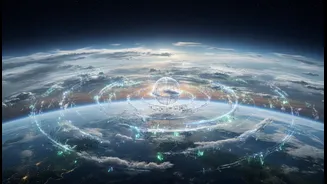
What happens in Antarctica does not stay in Antarctica. The continent is encircled by the world's largest ocean current, the Antarctic Circumpolar Current (ACC), which acts as a planetary thermostat, keeping warm waters away and regulating climate. Changes to this system have global consequences. As ice melts, the influx of fresh, cold water can disrupt this circulation. Recent observations have already detected a significant warming and slowing of the deep, cold Antarctic Bottom Water that flows northwards, a key part of the global ocean 'conveyor belt'. This slowdown has been linked to rising temperatures and sea levels in the North Atlantic, demonstrating a direct and immediate link between changes at the South Pole and conditions in the Northern Hemisphere. For a country like India with over 7,500 kilometres of coastline, the implications of accelerating sea-level rise driven by Antarctic melt are immense.